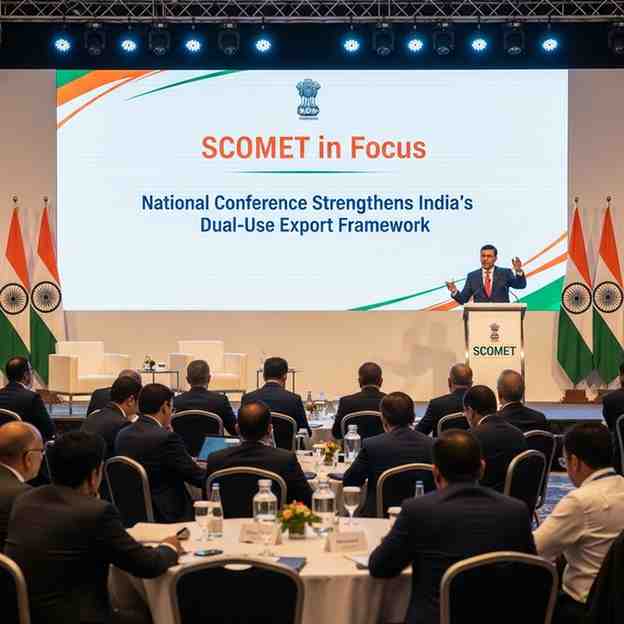
NCSTC 2026: India Consolidates Strategic Trade Controls Amid Global Tech Shifts
The National Conference on Strategic Trade Controls (NCSTC) 2026 recently convened in New Delhi, serving as a pivotal forum to review and strengthen India's framework for managing the export of sensitive technologies. Organised by the Directorate General of Foreign Trade (DGFT) in collaboration with the Ministry of External Affairs (MEA) and the Federation of Indian Export Organisations (FIEO) , the conference brought together government, industry, and international stakeholders to align India's controls with evolving global security and technological landscapes.
Strengthening the SCOMET Framework
The conference centred on India's SCOMET (Special Chemicals, Organisms, Materials, Equipment, and Technologies) list, which regulates the export of dual-use and sensitive items. Discussions aimed at enhancing awareness, compliance, and inter-agency coordination, ensuring that India's strategic trade controls are robust, transparent, and effectively prevent proliferation risks while facilitating legitimate high-tech commerce.
Launch of Updated Compliance Handbook
A key outcome was the release of the third edition of the Handbook on India’s Strategic Trade Control System . Prepared by DGFT in partnership with the MEA’s Disarmament & International Security Affairs (D&ISA) Division, this comprehensive guide provides updated procedural clarity and compliance requirements for exporters, researchers, and industry dealing with controlled goods and technologies.
Multi-Stakeholder Dialogue on Critical Themes
The conference featured high-level participation, including addresses by Commerce Secretary Rajesh Agrawal , CBIC Chairman Vivek Chaturvedi , DGFT Director General Lav Agarwal , and MEA Joint Secretary (D&ISA) Muanpuii Saiawi . Seven thematic sessions delved into critical areas: the SCOMET policy framework, licensing processes, enforcement, compliance systems, supply chain security, the Authorised Economic Operator (AEO) programme, and the complexities of Intangible Technology Transfer .
Addressing the Frontiers of Technology and Trade
Sector-specific discussions covered chemicals, biotechnology, aerospace, defence, and munitions controls. A significant focus was on emerging and frontier technologies —such as quantum technologies, advanced computing, semiconductors, and additive manufacturing—and their integration into the SCOMET list. With over 500 participants, NCSTC 2026 underscored India's commitment to a strategic trade control regime that upholds international non-proliferation obligations and national security, without unduly hindering technological advancement and export competitiveness.
🔍 Exam-Focused Points (Important Facts)
-
SCOMET is India's regulatory framework controlling the export of dual-use and sensitive items.
-
The Directorate General of Foreign Trade (DGFT) is the nodal authority for India's Strategic Trade Control system.
-
Intangible Technology Transfer refers to the non-physical transfer of technology/know-how, also covered under controls.
-
Strategic trade controls aim to balance national security and trade facilitation .
-
The conference highlights India's focus on regulating emerging technologies like quantum computing and semiconductors.
Month: Current Affairs - January 16, 2026
Category: Economy & InternalSecurity