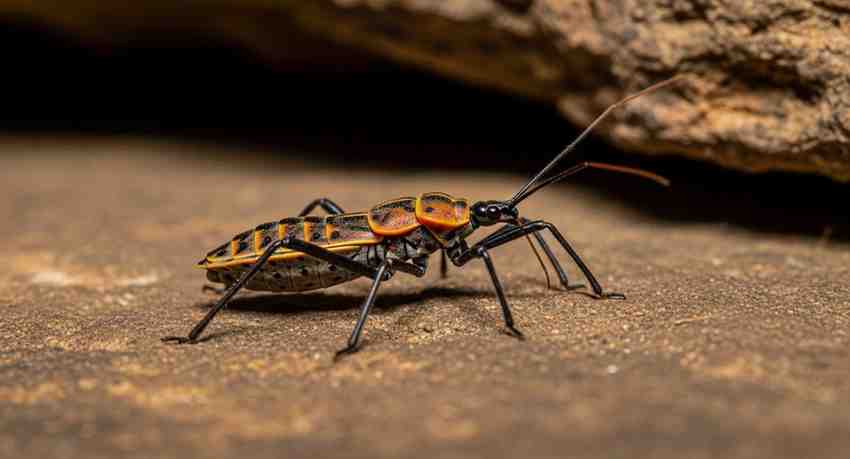
Century-Old Cave Insect Myiophanes kempi Found Again After Nearly 100 Years
Scientists have rediscovered Myiophanes kempi , a little-known insect species that had not been recorded for nearly a century. The rediscovery occurred in limestone caves of the Andaman Islands , drawing attention to the hidden biodiversity of subterranean ecosystems. The species was last documented in 1924, making the recent finding significant for entomology and biodiversity research. The discovery highlights how cave ecosystems can shelter rare organisms that remain undetected for decades.
Taxonomic Background of the Species
Myiophanes kempi belongs to the Reduviidae family. Insects in this family are known for their predatory behaviour and specialised hunting techniques used to capture prey.
The species was originally described in 1924 by British entomologist William Edward China . Early scientific records linked the insect to Siju Cave , indicating that cave habitats in India support unique and poorly studied insect species.
Adaptations to Cave Environments
Cave ecosystems are characterised by permanent darkness, limited food availability and stable environmental conditions. Organisms living in such habitats often develop specialised physical and behavioural adaptations.
Myiophanes kempi possesses elongated raptorial forelegs that allow it to grasp and immobilise prey such as small arthropods. Its slender body structure and predatory strategy enable it to survive in the nutrient-poor environment typical of subterranean habitats.
Ecological Importance of Cave Species
Subterranean organisms play a key role in maintaining the ecological balance of cave ecosystems. These species are often highly specialised and may exist only in restricted habitats.
The rediscovery of Myiophanes kempi suggests that many cave ecosystems remain poorly explored and may harbour additional undiscovered species. Research on such organisms provides insights into evolutionary adaptations and biodiversity patterns in extreme environments.
Siju Cave and Subterranean Biodiversity
Siju Cave , located in the Garo Hills , is one of the longest limestone cave systems in India, extending for about 4.7 kilometres . The cave lies near the Simsang River and is also known as Dobakkol or Bat Cave .
It is famous for its limestone formations, underground streams and specialised cave fauna, making it an important site for research on subterranean ecosystems.
Exam-Focused Points
-
Myiophanes kempi is a cave-dwelling insect belonging to the Reduviidae family.
-
The species was first described in 1924 by William Edward China .
-
It is adapted to subterranean cave ecosystems and preys on small arthropods.
-
Siju Cave in Meghalaya is one of India’s longest limestone caves.
-
Cave ecosystems are often biodiversity-rich but poorly explored habitats .
Month: Current Affairs - March 15, 2026
Category: Environment & Biodiversity / Zoology