Scientists Find Jurassic Dinosaur Eggs Preserved in Nest on Santa Cruz Beach
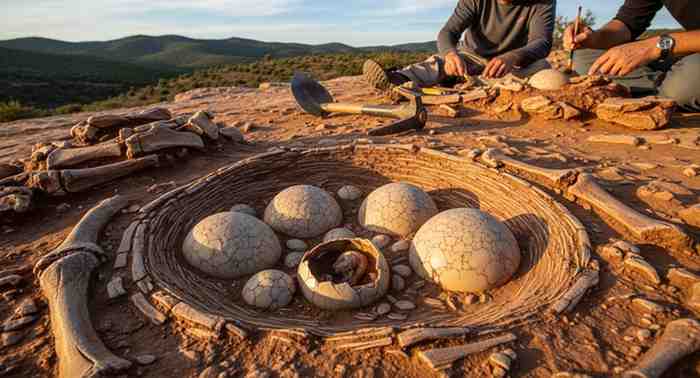
Scientists have uncovered a rare fossilised nest containing ten dinosaur eggs dating back nearly 150 million years along the cliffs of Santa Cruz Beach in Portugal . The discovery was made by researcher Carlos Natário from the Centre for Research in Paleobiology and Paleoecology , which operates under the Torres Vedras Natural History Society . The find offers valuable insights into dinosaur reproduction and the prehistoric ecosystems that existed during the Upper Jurassic period .
Fossilised Nest Found in Coastal Cliffs
The eggs were preserved within sandstone cliffs near Santa Cruz Beach in the Lisbon district . Researchers discovered the eggs grouped together in their original nest formation. Unlike many fossil discoveries where eggs are scattered by floods or geological shifts, these eggs remained intact and undisturbed. Geological analysis suggests the nest was located on a sandy riverbank where sediment quickly covered and preserved the eggs.
Insights Into Dinosaur Nesting Behaviour
The structure of the fossilised nest indicates deliberate nesting behaviour by the dinosaur. The surrounding sandstone contains granular material typical of riverbank environments. Such soft sandy surfaces would have allowed eggs to be gently buried soon after being laid. The lack of water disturbance helped keep the eggs in their original positions rather than dispersing them.
Use of CT Scanning Technology
After the excavation, the rock block containing the eggs was transported to the laboratory of the Torres Vedras Natural History Society. Researchers are now using CT Scan to perform a virtual excavation . This method allows scientists to generate detailed three-dimensional images of the fossils without damaging them. The scans may reveal embryonic bones and provide information about eggshell structure and development.
Exam-Focused Key Points
-
Upper Jurassic Period: Approximately 163–145 million years ago .
-
Theropods: Two-legged carnivorous dinosaurs common in Jurassic and Cretaceous periods.
-
CT Scanning: Used in palaeontology to examine fossils without physical damage.
-
Portugal has yielded several important Jurassic dinosaur fossil discoveries .
-
The eggs measure roughly 5 cm in diameter .
Month: Current Affairs - March 10, 2026
Category: Science & Technology