RSETIs Strengthening Rural Livelihoods and Entrepreneurship
The Ministry of Rural Development has emphasised the expanding role of Rural Self Employment Training Institutes (RSETIs) in enhancing skills and promoting self-employment among rural youth. These institutions are emerging as key drivers of grassroots entrepreneurship and sustainable livelihoods.
About Rural Self Employment Training Institutes
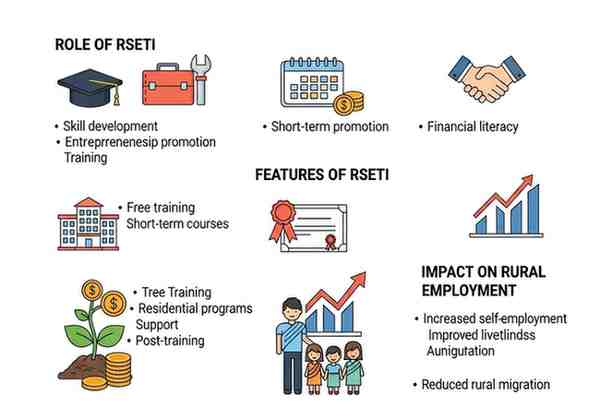
RSETIs are specialised training centres designed to equip unemployed rural individuals with practical skills. They focus on enabling self-employment through structured, need-based programmes. The institutes offer free residential training, ensuring inclusivity for economically weaker sections and improving accessibility across rural regions.
Collaborative Institutional Model
RSETIs function under a unique partnership between the government and the banking sector. Each district hosts one institute, generally managed by the lead bank of that district. This arrangement facilitates smooth coordination, financial inclusion and easy access to institutional credit for trained candidates.
Training Structure and Skill Development
The institutes conduct short-term, intensive training programmes for individuals aged 18 to 50 years. Around 73 courses are offered, aligned with the National Skills Qualifications Framework, covering sectors such as agriculture, manufacturing, services and micro-enterprise development. The training emphasises practical learning and entrepreneurial skills.
Exam-Focused Points
-
RSETIs: Skill training institutes for rural unemployed youth
-
Training: Free and residential
-
Model: Bank + Government partnership
-
Coverage: One RSETI per district
-
Courses: Aligned with NSQF (73 programmes)
Impact and Outreach
Currently, 632 RSETIs operate across 619 districts in 33 States and Union Territories, supported by 25 banks. These institutes provide post-training assistance such as mentoring and credit linkage. Certificates issued by RSETIs are widely accepted by banks, easing access to loans and fostering rural entrepreneurship.
Month: Current Affairs - March 29, 2026
Category: Governance, Welfare Schemes