Overview
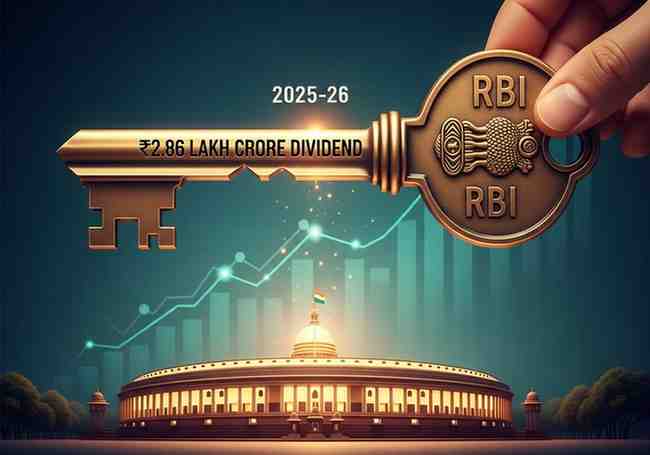
On 22 May 2026, the Reserve Bank of India (RBI) approved a dividend of ₹2,86,588.46 crore for the Central Government. This is for the accounting year 2025-26. The amount is the largest surplus transfer in RBI’s history. It is 6.7% higher than the ₹2.69 lakh crore transferred in 2024-25. The decision was taken at the 623rd meeting of RBI’s Central Board of Directors in Mumbai. Governor Sanjay Malhotra chaired the meeting. This dividend will help the government manage its finances and reduce its fiscal deficit.
What Is the RBI Dividend Framework?
The Reserve Bank of India transfers surplus income to the Central Government every year. This is part of its annual balance sheet and profit distribution process. The dividend is calculated after meeting all expenses, making necessary provisions, and maintaining risk buffers. The RBI follows a clear accounting framework for this. The surplus comes from various sources like interest on government bonds, foreign exchange operations, and other earnings. After setting aside money for risks and contingencies, the remaining profit is paid to the government. This payment is a non-tax revenue receipt for the Union Government. It is recorded in the Union Budget under receipts from the central bank.
The Central Board of Directors Meeting
The decision was taken at the 623rd meeting of the Central Board of Directors of the RBI. The meeting was held in Mumbai. Governor Sanjay Malhotra chaired the meeting. The board reviewed the RBI’s accounts for the financial year 2025-26. After discussion, they approved the surplus transfer of ₹2,86,588.46 crore to the Central Government. This is the highest ever dividend paid by the RBI. The previous record was ₹2.69 lakh crore in 2024-25. The increase is 6.7% over last year.
Income, Balance Sheet, and Risk Buffer
The RBI reported strong financial performance in 2025-26. Its gross income rose by 26.42% compared to the previous year. The net income before risk provisions increased to ₹3.96 lakh crore in FY26, up from ₹3.13 lakh crore in FY25. This growth came from higher interest earnings and foreign exchange gains.
The RBI’s balance sheet also expanded significantly. As of 31 March 2026, the balance sheet size was ₹91,97,121.08 crore. This is an increase of 20.61% over the previous year. The larger balance sheet reflects the central bank’s growing operations and holdings.
The Contingent Risk Buffer (CRB) is a reserve maintained by the RBI to meet unexpected risks. For FY26, the board decided to retain the CRB at 6.5% of the balance sheet size. The RBI transferred ₹1,09,379.64 crore to this buffer during the year. This ensures the central bank remains strong enough to handle any future shocks.
Why Is This Dividend Important for the Government?
The RBI’s dividend is a key source of non-tax revenue for the Central Government. It helps the government meet its expenditure without raising taxes or borrowing more. In 2026, the government faces many spending needs. These include infrastructure projects, welfare schemes, and defence modernisation. A record dividend of ₹2.86 lakh crore will provide a big financial cushion. It can help reduce the fiscal deficit, which is the gap between government income and spending. A lower deficit is good for the economy. It keeps inflation in check and maintains investor confidence.
A Human Touch: What This Means for You
You might wonder what a bank’s dividend has to do with your life. The answer is: quite a lot. When the
Month: Current Affairs - May 23, 2026
Category: Economy, Banking