Overview :
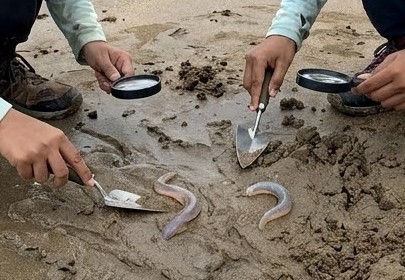
Pune's Agharkar Research Institute has discovered two new species of microscopic marine organisms— Psammophaga holzmannae and Psammophaga sinhai —at Rajapuri Creek in Maharashtra's Raigad district. These 'sand eaters' selectively pick up titanium and iron minerals from the seafloor.
What Are Foraminifera?
Foraminifera are a diverse group of single-celled marine organisms, often with shells. They play a key role in ocean ecosystems. These two new species belong to the Psammophaga genus.
Why the Discovery Matters
-
Selective Feeding The discovery shows that these organisms can distinguish between mineral grains—a rare behaviour.
-
Marine Biodiversity Adds to our understanding of India's coastal biodiversity.
-
Environmental Indicators Because they are sensitive to environmental changes, these organisms can act as indicators of marine health.
A Closer Look
The Detection Mechanism
They use hair-like extensions to "feel" the sediment and choose specific grains—a behaviour that is still not fully understood.
Exam-Focused Points :
-
Names Psammophaga holzmannae and Psammophaga sinhai
-
Discovered by Scientists from Pune's Agharkar Research Institute (ARI)
-
Location Rajapuri Creek, Raigad district, Maharashtra (Konkan coast)
-
Classification They are foraminifera—a group of microscopic marine organisms.
-
Name Origin Greek for "sand eater."
-
Feeding Behavior Selectively swallow heavy minerals like ilmenite and magnetite.
-
Size P. holzmannae (103–246 µm) is smaller; P. sinhai (279–448 µm) is larger.
FAQs :
Q1: What are these new organisms?
Two new species of microscopic marine organisms that swallow sand and select specific minerals.
Q2: What does "Psammophaga" mean?
It means "sand eater" in Greek.
Q3: Where were they found?
At Rajapuri Creek in Raigad district, along Maharashtra's Konkan coast.
Q4: What makes them special?
They selectively eat heavy minerals like ilmenite and magnetite, which are rare in the sediment.
Q5: How do they eat?
They use hair-like extensions (granuloreticulopodia) to detect and pick up specific mineral grains.
Month: Current Affairs - Aug 21, 2026
Category: Biology – Foraminifera