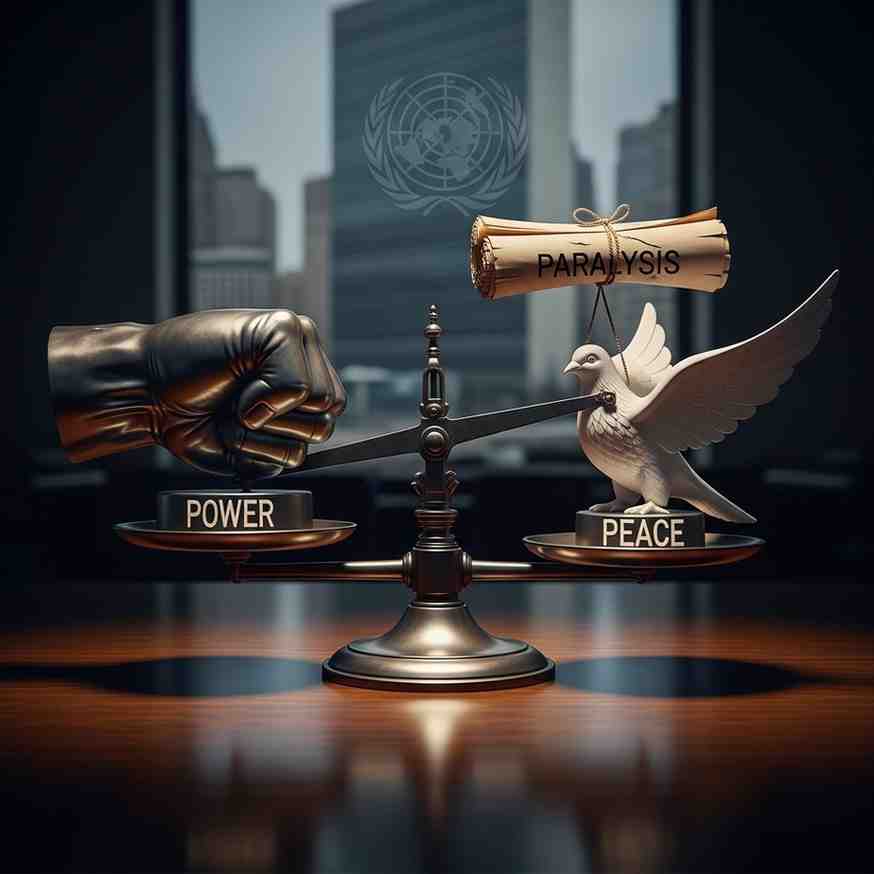
The United States’ military action to seize Venezuelan President Nicolás Maduro has reignited an old and deeply uncomfortable question: is the global system for maintaining peace, built around the United Nations , still capable of restraining powerful states? Coming after Russia ’s invasion of Ukraine and amid the continuing devastation in Gaza, the episode has sharpened doubts about whether the UN can still fulfil its most fundamental promise — preventing the unilateral use of force.
What unsettled the UN system
The reported U.S. operation represents a direct use of force against a sovereign state without authorisation from the UN’s collective security framework. Under the UN Charter, military force is lawful only in two circumstances: when authorised by the Security Council, or when exercised in self-defence in response to an armed attack.
In Venezuela’s case, neither justification appears straightforward. There was no Security Council mandate, and claims of self-defence rest on contested interpretations of security threats. For many observers, this reinforces a troubling pattern: major powers increasingly act first and engage international institutions later — if at all. The UN, rather than being the forum that restrains force, is left to react after the fact.
How the system is meant to work
The primary responsibility for maintaining international peace and security lies with the United Nations Security Council . Its structure reflects the post–Second World War compromise between idealism and power politics. Of its 15 members, five — the United States, Russia, China, France and the United Kingdom — are permanent and wield veto power; the remaining ten are elected for two-year terms.
For the Council to authorise military action, at least nine members must vote in favour and none of the permanent five may veto the resolution. This design was intended to ensure that enforcement action would be collective and that the major powers would manage global order together, rather than through direct confrontation.
The veto as the central fault line
In practice, the veto has become the system’s most disabling feature. When a permanent member is itself party to a conflict, meaningful Council action becomes nearly impossible. Russia’s veto has paralysed responses to Ukraine; U.S. vetoes have long shaped outcomes in the Middle East; and now Washington’s own actions place it beyond the reach of the very institution it dominates.
Legally, this paralysis is not an accident. The UN Charter imposes no enforceable limits on veto use, even when it shields a state’s own conduct. There is no global court with authority to override Security Council decisions. The result is a stark hierarchy: the states entrusted with upholding international peace are structurally insulated from accountability.
Can the system be fixed?
Calls for reform are frequent but rarely realistic. Charter amendments are theoretically possible, but they require the consent of the permanent five — including those whose power reform would constrain. Proposals to curb veto use in cases of mass atrocities, or to expand permanent membership, have circulated for decades without success.
More radical ideas — dissolving and reconstituting the UN under a new charter — face even steeper odds. At a time of intensifying geopolitical rivalry, the consensus required for such a transformation is virtually unimaginable. Any redesign that diluted veto power would almost certainly be blocked by at least one major power.
Why the UN is more than the Security Council
Month: Current Affairs - January 08, 2026
Category: