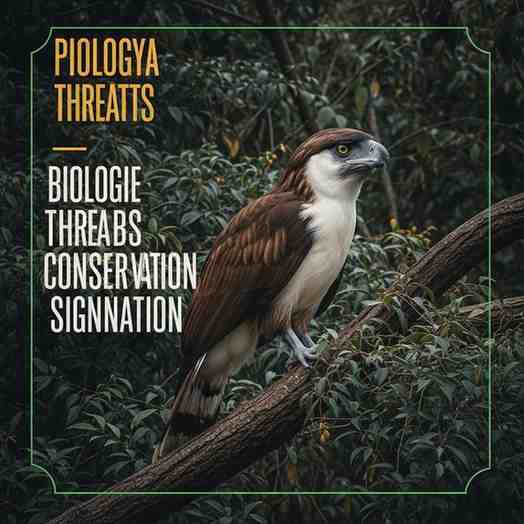
Pithecophaga jefferyi: The Critically Endangered Apex Predator of the Philippines
The Philippine eagle ( Pithecophaga jefferyi ) is among the world’s most formidable raptors, renowned for its size, strength, and ecological role. Endemic to the Philippines, it holds deep national and conservation significance. Despite its dominance as an apex predator, the species faces an alarming survival crisis, with fewer than 500 mature individuals estimated in the wild.
Origins of the ‘Monkey-Eating’ Nickname
The eagle’s popular label emerged from early observations of it preying on monkeys. While primates feature in its diet, the species is an opportunistic hunter feeding on flying squirrels, civets, bats, reptiles, and other small vertebrates. As a diurnal predator, it plays a crucial role in regulating prey populations and sustaining forest ecosystem balance.
Size and Distinctive Adaptations
The Philippine eagle ranks among the largest eagles by body length, measuring 76–102 cm, with a wingspan approaching 1.9 metres. Females typically outweigh males, consistent with sexual dimorphism seen in many birds of prey.
Its massive hooked beak and powerful talons, reaching lengths of up to 7.6 cm, enable efficient predation in dense forest environments. Unlike open-habitat raptors, its relatively shorter wings and long tail enhance manoeuvrability through thick canopies.
Habitat Specialisation and Decline
The species inhabits limited island regions including Luzon, Samar, Leyte, and Mindanao. It depends on intact dipterocarp forests, a dominant tropical rainforest type in Southeast Asia. Each breeding pair requires extensive territory, often exceeding 100 square kilometres, making it highly sensitive to habitat fragmentation.
Rapid deforestation driven by logging, agricultural expansion, mining, and infrastructure projects has drastically reduced viable habitat.
Slow Reproductive Cycle
Philippine eagles exhibit low reproductive rates, typically producing a single egg every two years. Delayed sexual maturity further constrains population recovery.
Exam-Focused Points
-
Species → Philippine eagle ( Pithecophaga jefferyi )
-
Distribution → Endemic to the Philippines
-
IUCN Status → Critically Endangered
-
Habitat → Dipterocarp tropical forests
-
Ecological Role → Apex predator
-
Reproduction → One egg every two years
Month: Current Affairs - February 15, 2026
Category: Environment & Ecology