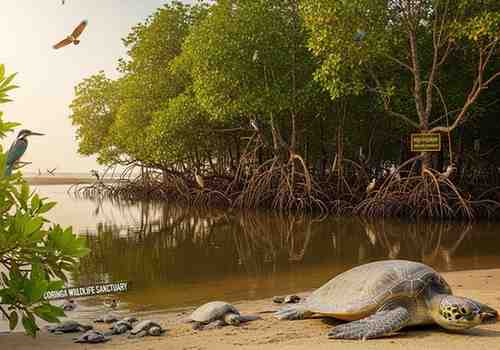
Olive Ridley Turtle Egg Conservation at Coringa
Authorities from the Wildlife Management Authority and Coringa Wildlife Sanctuary have safeguarded nearly 20,000 eggs of Olive Ridley turtle on Hope Island. This initiative highlights the importance of coastal conservation and targeted efforts to protect marine biodiversity.
About Coringa Wildlife Sanctuary
Coringa Wildlife Sanctuary lies in the Godavari estuary, where the Coringa River meets the Bay of Bengal. Established in 1978, it is renowned for hosting India’s second-largest mangrove ecosystem. The sanctuary consists mainly of dense mangrove forests along with pockets of tropical dry deciduous vegetation, making it ecologically significant.
Flora and Faunal Diversity
The sanctuary supports rich mangrove vegetation, including species like Rhizophora, Avicennia and Sonneratia. It provides habitat for species such as the smooth-coated otter and fishing cat. The region is also a major bird habitat, hosting species like the Brahminy kite, black-capped kingfisher, gulls and sandpipers, reflecting its wetland importance.
Olive Ridley Turtles and Nesting Pattern
Olive Ridley turtles are known for their mass nesting behaviour called arribada, where thousands of females come ashore simultaneously to lay eggs. These turtles are widely distributed across tropical oceans, including the Indian Ocean. The Coringa coastline offers suitable nesting grounds due to its sandy beaches and favourable environmental conditions.
Exam-Focused Points
-
Coringa Wildlife Sanctuary: Located in Andhra Pradesh (Godavari estuary)
-
Feature: Second-largest mangrove forest in India
-
Olive Ridley turtle: Marine species with arribada nesting
-
IUCN status: Vulnerable
-
Wildlife Protection Act: Schedule I species
Conservation Significance
Protecting Olive Ridley turtle eggs helps maintain marine biodiversity and ensures species survival. Mangrove ecosystems also act as natural shields against coastal erosion and extreme weather events. Conservation initiatives in such habitats play a critical role in ecological stability and climate resilience.
Month: Current Affairs - March 29, 2026
Category: Environment, Biodiversity