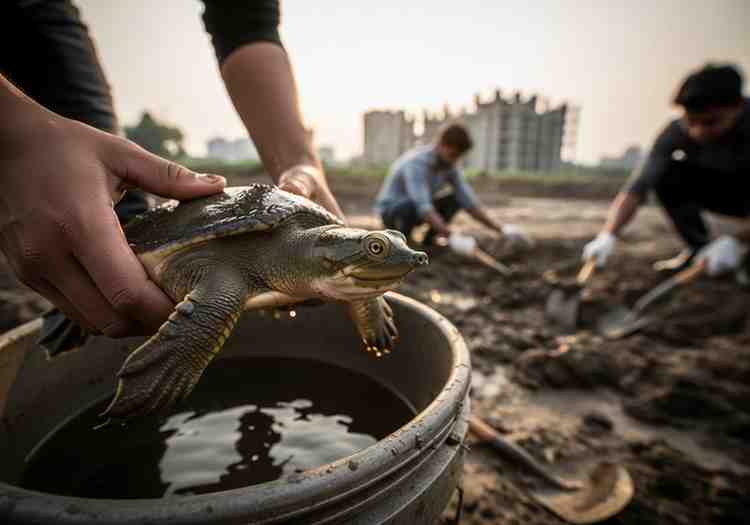
Rescue Highlights Wildlife Trafficking.
Recently, the Indian Softshell turtles were found in Greater Noida by authorities and rescued after a routine check. The event has once again highlighted the current problem of poaching wildlife in India and why the endangered aquatic life should be taken care of.
About Indian Softshell Turtle.
The Indian Softshell Turtle (Nilssonia gangetica) or the Ganges Softshell turtle is considered one of the largest freshwater turtles of the globe. It possesses a green shell oval in shape and margin yellow. The long neck and tube-shaped snout make it able to breath and maintain its underwater condition which is why it is highly adapted to underwater life. The shell is soft and therefore it is fast in water.
Habitat and Distribution
Its distribution is in freshwater rivers, lakes, ponds, and canals that have a sandy or muddy base. It likes murky waters where it can be concealed under the substrate. It covers such countries as India, Afghanistan, Bangladesh, and Pakistan. It is also decentralized in the great river systems of India such as the Ganga, Brahmaputra, Yamuna, and Narmada.
Diet and Behaviour
The Indian Softshell turtles are omnivorous. They feed on fish, insects, molluscs, amphibians, carrion and aquatic vegetation. They are important ecologically as they clean up water bodies and manage the population of prey. Breeding season normally takes place between February and April. They are also safeguarded in certain parts of the country particularly in Odisha because of religious reasons.
Exam-Focused Points
- Family name: Nilssonia gangetica.
- IUCN status: Endangered
- Law: Wildlife Protection Act, 1972, schedule I.
- Location: Freshwater rivers and ponds.
- Characteristic: Soft shell and tube snout.
Threats and Conservation.
Habitat loss, pollution, and poaching of the species to be used as meat and traditional products are all a threat to the species. Even with the high level of legal protection, there are still loopholes in the enforcement and demand in the illicit markets. Protecting the habitat, enforcing the law more strictly, and raising awareness among the population should be the primary conservation strategies.
Month: Current Affairs - April 07, 2026
Category: Environment - Biodiversity