Overview
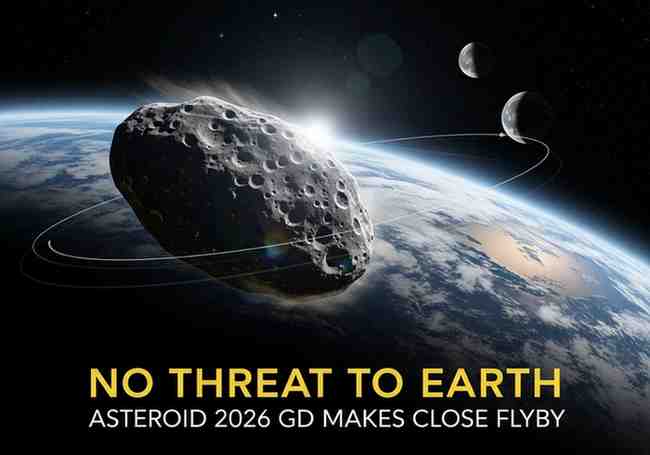
On April 9, an asteroid, Asteroid 2026 GD, flew near Earth, and it caught the attention of scientists and space agencies. Although it is said to be house-sized and even flies nearer than the orbit of the Moon, the experts have assured that it is not threatening. The incident underscores continued activities by the world, especially NASA, to spy on objects that travel close to the orbit of the planet.
Size and Classification
The size of asteroid 2026 GD is approximately 54 feet in diameter, or about the size of a small house. It is also a part of a group of Near-Earth Objects (NEO), which are comprised of asteroids and comets, whose paths cause them to orbit relatively close to Earth. Such small asteroids are quite common and frequently pass by without causing concern.
Distance of Closest Approach
The asteroid flew past the earth at a distance of about 156,000 miles (about 251,000 kilometres). This is nearer than the average distance of the Moon to the Earth that is approximately 384,400 kilometres. This might seem alarming but the distance is so big that it will be completely safe.
Risk Assessment
When NASA proclaimed that Asteroid 2026 GD is not one of the potentially hazardous objects. To be regarded as dangerous, an asteroid should fulfill certain conditions connected to the size and orbit. In this example, its path bypasses it safely and such near whizzes are common occurrences in the cosmic world of the earth.
Importance of Monitoring
Planetary defence requires the monitoring of near-Earth objects. The constant monitoring of these objects aids scientists in making correct predictions of the orbits and determining any possible threats in the future. It also contributes to the knowledge on the formation and evolution of the Solar System, and such events are both safety and scientific valuable.
Exam-Focused Key Points
- Near Earth Objects (NEOs) are asteroids and comets in the orbit of the Earth.
- Asteroid 2026 GD is about 54 feet in diameter.
- Closest distance: ~251,000 km from Earth.
- Moon’s average distance: ~384,400 km.
- NASA keeps an eye on NEOs.
Month: Current Affairs - April 09, 2026
Category: Space Technology