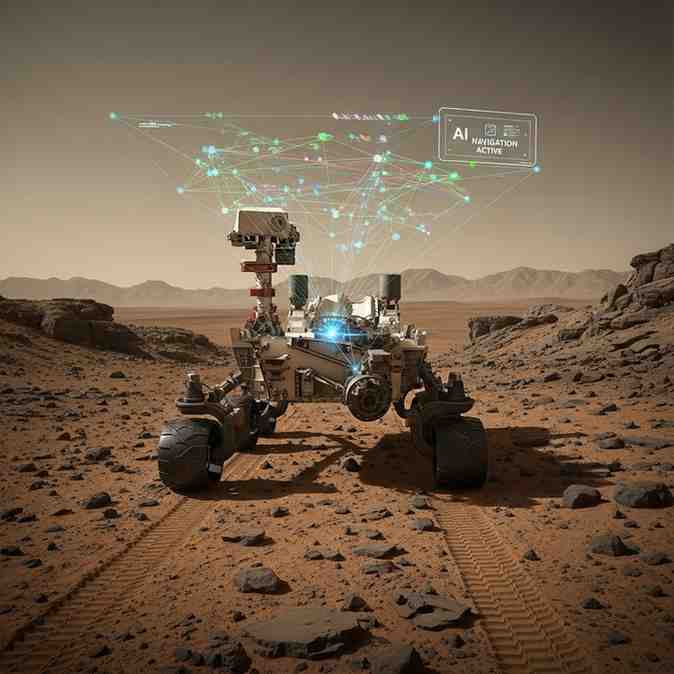
NASA Achieves First AI-Planned Autonomous Rover Drives on Mars
NASA has marked a historic milestone in planetary exploration as the Perseverance rover successfully completed the first-ever autonomous drives on another planet that were fully planned by artificial intelligence . The breakthrough showcases how advanced AI can independently analyse terrain and chart safe routes on Mars, significantly reducing dependence on human operators on Earth.
Historic Autonomous Navigation Test
The achievement took place on December 8 and 10, when Perseverance executed two rover drives whose routes were designed entirely by AI software developed at NASA Jet Propulsion Laboratory . Unlike conventional operations—where human planners manually select waypoints—the AI system independently interpreted Martian surface data and generated complete navigation plans.
How AI Planned the Martian Route
The system relies on a vision-enabled generative AI model trained on mission datasets similar to those used by rover planners. It analysed slopes, surface roughness, rocks, and sand hazards using high-resolution images and elevation data from the Mars Reconnaissance Orbiter , particularly the HiRISE camera. Based on this assessment, the AI generated a continuous, hazard-aware route with precise waypoints, allowing Perseverance to traverse boulder fields and uneven terrain autonomously.
Testing, Safety Checks, and Mission Results
Before commands were sent to Mars, the AI-generated plans were rigorously validated using a digital twin of the rover at JPL. Engineers checked more than 500,000 telemetry variables to ensure safety and compatibility with onboard flight software. During the first AI-planned drive, Perseverance travelled 210 metres, followed by a second drive of 246 metres two days later—both completed successfully without human route planning.
Important Facts for Exams
-
Perseverance is exploring Jezero Crater on Mars.
-
AI-planned drives reduce reliance on Earth-based human controllers.
-
Communication delays between Earth and Mars prevent real-time control.
-
HiRISE provides some of the highest-resolution images of the Martian surface.
Future of Autonomous Space Exploration
Mars lies, on average, about 225 million kilometres from Earth, creating communication delays of several minutes one way. By enabling rovers to plan and execute routes independently, NASA can increase mission efficiency, cover more challenging terrain, and expand scientific discovery. Officials say such responsible use of AI will be critical for future missions to Mars, asteroids, and deep-space destinations where autonomy will be essential for long-duration robotic and human exploration.
Month: Current Affairs - February 02, 2026
Category: Space Technology | Artificial Intelligence