Overview
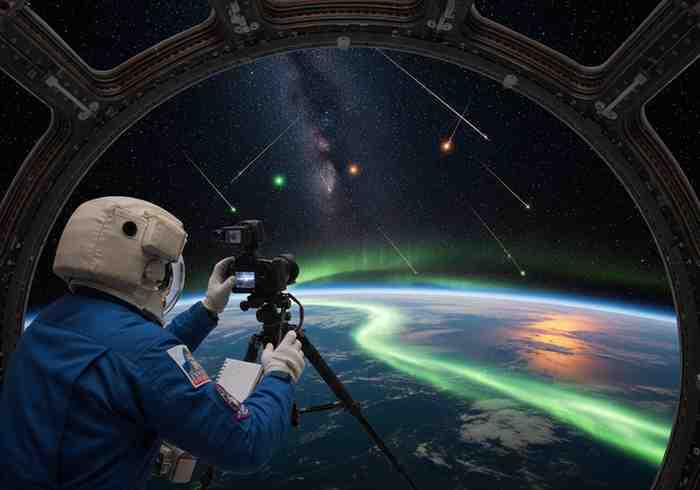
Jessica Meir posted a rare photo of the Lyrid meteor shower taken on the International Space Station. The photograph was captured using the cupola window of the station and captures meteors flying through the atmosphere of the earth, giving a special orbital view of this every year event.
What is the Lyrid Meteor Shower?
Among the oldest meteor showers known, Lyrid is one of the meteor showers that have been observed more than 2,700 years ago. It takes place in April every time the Earth goes through the debris that was left by Comet C/1861 G1 Thatcher. When these particles gain entry into the atmosphere, they are burnt up through friction and hence bright streaks that are called shooting stars are formed. The shower is usually at its peak on the 21-22 of April and is observed best in the Northern Hemisphere.
Special View of the ISS.
Meier took the shot out of the ISS cupola with a three-second exposure. This method produced belts of city lights on the planet and isolated the meteor as a bright streak towards the horizon. The cupola module which is a panoramic observation module enables astronauts to record such rare astronomical occurrences in space.
Public Engagement and Skywatching
Jessica Meir urged the skywatchers to view the Lyrids on the earth. She recommended that the constellation of Lyra in the eastern sky be looked at in the late hours of the night or in the early morning. The viewers can also see the ISS fly overhead and this makes the viewing experience more enjoyable.
Scientific and Educational Importance.
These images fill the information gap between space science and, the general population. They emphasize the narrowness of the atmosphere surrounding the Earth and stimulate the desire to study astronomy. Outreach led by astronauts is an important part of the process of making space phenomena more approachable and encouraging people to develop a desire to learn about science.
Exam-Focused Key Points
-
The Lyrid meteor shower takes place every year in April; associated with Comet C/1861 G1 Thatcher.
-
It is one of the oldest meteor showers (2,700+ years) ever recorded.
-
Best seen in the Northern Hemisphere; peaks around April 2122.
-
ISS cupola makes it possible to observe the space and take pictures.
-
Communicating about science as an astronaut.
MCQ
Q1. The Lyrid meteor shower is associated with which comet?
A. Halley’s Comet
B. Comet Encke
C. Comet C/1861 G1 Thatcher
D. Comet Hale-Bopp
Answer: C
Explanation: Lyrid meteor shower takes place at the time when the earth passes through debris of Comet C/1861 G1 Thatcher and the particles burn in the atmosphere and create visible meteors.
Month: Current Affairs - April 21, 2026
Category: Space - Astronomy