Overview
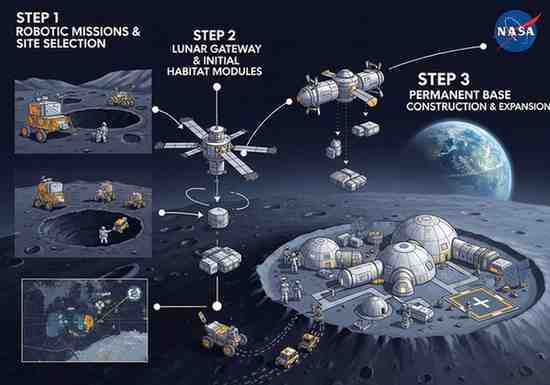
NASA will build a Moon base near the lunar South Pole by 2036. The $20 billion plan has three phases. First, robots deliver cargo. Second, astronauts build small habitats. Third, people live there all the time. This is part of the Artemis programme.
Introduction: A Big Step for NASA
On 24 March 2026, NASA announced a new plan. The plan is for a permanent Moon base. The base will be near the lunar South Pole. NASA reaffirmed this plan on 27 May 2026. The total cost is $20 billion over seven years. This Moon base is part of the Artemis programme. Artemis aims to keep humans on the Moon for a long time. Later, the same technology will help people go to Mars.
Why the Moon’s South Pole?
NASA chose the South Pole for a good reason. The South Pole has dark craters. Sunlight never reaches some parts of these craters. These areas are called permanently shadowed regions. Scientists think water ice may be hidden there. Water ice can become drinking water. It can also become rocket fuel. This makes the South Pole very important for long-term stays.
Phase One: Robots and Cargo First (2026–2029)
Phase one runs through 2029. In this phase, NASA will send robots and cargo. They will also test new technology on the Moon’s surface. NASA plans up to 25 missions. Out of these, 21 will land on the Moon. The Commercial Lunar Payload Services (CLPS) programme will help. Private companies will deliver equipment. The Lunar Terrain Vehicle programme will also start.
The first small base is called Moon Base-I. It is planned no earlier than autumn 2026. Blue Origin will provide the lander. The lander is named Blue Moon Mark 1 Endurance. It will land at the Shackleton Connecting Ridge. This mission will deliver equipment. It will also reduce risks before astronauts arrive.
Phase Two: Building Early Homes (2029–2032)
Phase two starts in 2029 and ends in 2032. In this phase, NASA will build early semi-habitable structures. These are not full houses yet. But astronauts can stay for weeks or months. The plan includes:
-
Power grids for electricity
-
Surface communication systems to talk with Earth
-
Mobility systems like rovers to move around
Astronauts will visit often. They will stay longer each time. This phase prepares the Moon for permanent residents.
Phase Three: A Permanent Moon Base (through 2036)
Phase three extends to 2036. NASA aims for a fully permanent base. Humans will live there continuously. Crewed landings will happen every six months. Astronauts will do science experiments. They will also test new technology for Mars. This base will be a stepping stone to deeper space.
Exam Points to Remember
-
Moon’s South Pole has permanently shadowed craters and possible water ice.
-
Commercial Lunar Payload Services (CLPS) buys delivery services from private companies.
-
Lunar Gateway is a planned Moon-orbiting
Month: Current Affairs - May 28, 2026
Category: NASAMoonBase2026