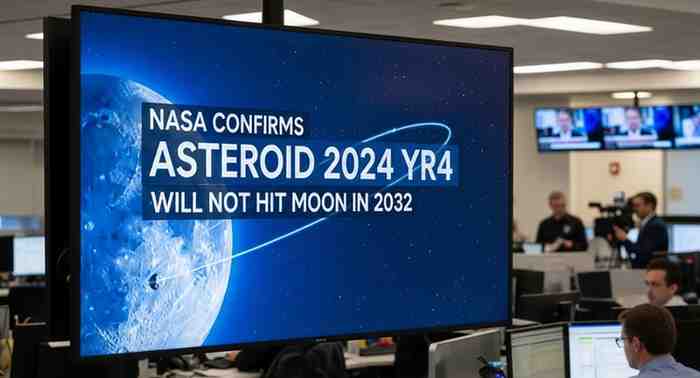
James Webb Observations Rule Out Lunar Impact Risk from Asteroid 2024 YR4
The NASA has confirmed that Asteroid 2024 YR4 will not collide with the Moon in 2032. Earlier orbital estimates had indicated a small probability of a lunar impact on December 22, 2032 , but improved observations and refined calculations have now eliminated any possibility of collision with either the Moon or Earth.
Initial Predictions and Monitoring
After its discovery in late 2024, Asteroid 2024 YR4 was classified as a near-Earth object (NEO) requiring close observation. Early trajectory models suggested a 3.8%–4.3% chance of the asteroid striking the Moon.
Such probabilities are common when an asteroid is first detected because scientists initially have only a limited number of observations. With incomplete data, orbital predictions contain uncertainties, which are gradually reduced as more measurements become available.
Role of the James Webb Space Telescope
To improve the accuracy of the asteroid’s predicted path, researchers from NASA's Centre for Near-Earth Object Studies used the James Webb Space Telescope .
In February, the telescope successfully recorded two observations of the asteroid while it appeared extremely faint. These high-precision measurements provided crucial information that allowed scientists to refine the object’s orbital parameters.
Safe Passage Near the Moon
Using the updated data, astronomers recalculated the asteroid’s trajectory and concluded that Asteroid 2024 YR4 will safely pass the Moon at an approximate distance of 21,200 kilometres .
Earlier evaluations also assessed the possibility of an Earth impact. Subsequent calculations have ruled out any risk of collision with Earth for at least the next hundred years .
Understanding Asteroid Impact Probabilities
Astronomers emphasise that changing impact probabilities are a normal aspect of asteroid tracking. When an asteroid is first identified, orbital estimates are based on minimal observational data, resulting in wide uncertainty ranges.
As additional observations are collected from telescopes and tracking systems, scientists refine the trajectory calculations and eliminate unlikely scenarios. In this case, improved data confirmed that the 65-metre-wide asteroid poses no danger to Earth or the Moon .
Exam-Focused Points
-
Near-Earth Objects (NEOs) are asteroids or comets whose orbits approach Earth’s orbital path.
-
NASA's Centre for Near-Earth Object Studies tracks and evaluates potential asteroid hazards.
-
The James Webb Space Telescope is used for high-precision observations of distant celestial objects.
-
Planetary defence involves monitoring and potentially deflecting asteroids that could threaten Earth.
-
Continuous observation helps refine orbital predictions and eliminate collision risks .
Month: Current Affairs - March 14, 2026
Category: Science & Technology