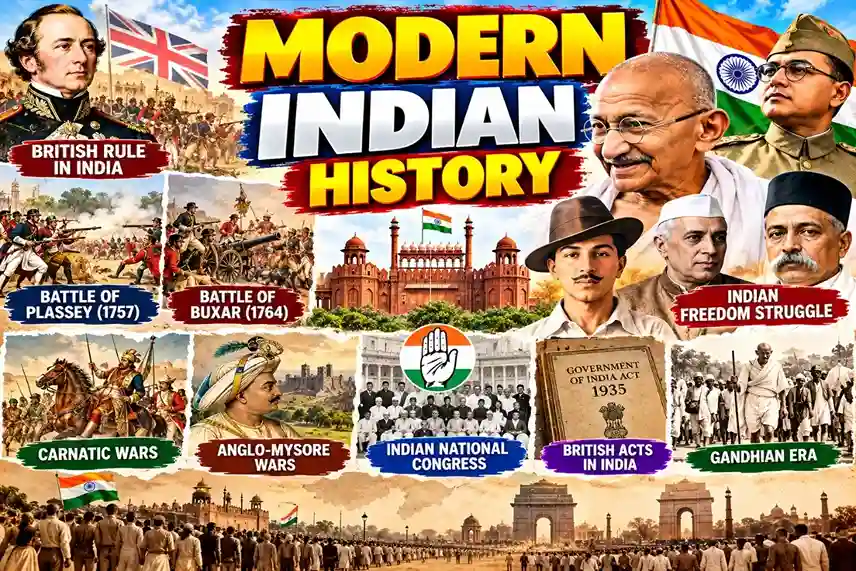
Overview :
Study complete Modern Indian History notes covering European arrival, British expansion, 1857 Revolt, Congress, Gandhi, freedom struggle, British Acts and major movements for UPSC, SSC and other exams.
Part A: Indian Freedom Struggle
1. European Arrival in India
- India had strong trade links with Europe from ancient times.
- Indian cotton, silk, textiles and spices were in high demand in Europe.
- Before the direct sea route, much of the trade passed through Arab and Venetian merchants.
- The capture of Constantinople by the Ottoman Turks in 1453 affected the old trade routes.
- European countries started searching for direct sea routes to Asia.
- Portugal and Spain took the lead in this search.
- Christopher Columbus sailed in 1492 but reached America.
- Vasco da Gama reached Calicut on 20 May 1498.
- This opened a direct sea route between Europe and India.
2. Portuguese in India
Arrival of the Portuguese
- Vasco da Gama was the first Portuguese sailor to reach India by the new sea route.
- He was welcomed by the Zamorin of Calicut.
- He returned to India in 1501.
- A Portuguese trading factory was established at Kannur.
Rise of Portuguese Power
- Francisco de Almeida became the first Portuguese Governor in India.
- His policy focused on naval control in the Indian Ocean.
- This policy is known as the Blue Water Policy .
- The Cartaz System was an important part of Portuguese naval control.
- Traders needed a Portuguese pass to conduct trade in the Indian Ocean.
Albuquerque
- Afonso de Albuquerque captured Goa in 1510.
- He is generally associated with the consolidation of Portuguese power in India.
- Portuguese control later spread to other coastal areas.
- They also captured important locations outside India.
Decline of Portuguese Power
- Portuguese power declined from the 16th century onward.
- They lost Hooghly in 1631.
- Bombay passed to England in 1661.
- Marathas captured Salsette and Bassein in 1739.
- Portuguese control remained mainly around Goa and other settlements until the 20th century.
Portuguese Contributions
- Portuguese missionaries played an important role in Christian missionary work.
- St. Francis Xavier arrived in India in 1542.
- The Portuguese are associated with the introduction of crops such as:
- Tobacco
- Tomato
- Potato
- Chilli
- India's first printing press was established at Goa in 1556 .
3. Dutch East India Company
- The Dutch East India Company was established in the early 17th century.
- The Dutch entered India mainly for trade.
- Their first important factory was established at Masulipatnam.
- Pulicat became their major centre.
- They established factories at:
- Surat
- Chinsura
- Patna
- Balasore
- Nagapattinam
- Cochin
- The Dutch became important in the spice trade.
- They also exported cotton textiles, indigo, silk and opium.
- Their rivalry with the English weakened Dutch power.
- The Battle of Bedara/Chinsura in 1759 was an important defeat for the Dutch.
- The Dutch East India Company was later liquidated.
4. English East India Company
Establishment
- English merchants formed the East India Company in 1599.
- Queen Elizabeth I granted the Company a charter on 31 December 1600 .
- The Company received a monopoly over English trade with the East.
Early British Expansion
- Captain William Hawkins visited Jahangir's court.
- The English defeated the Portuguese near Surat in the Battle of Swally .
- The Company established a factory at Surat in 1613.
- Sir Thomas Roe visited Jahangir's court.
- The Company later received permission to establish more factories.
Major Settlements
- Madras was obtained in 1639.
- Fort St. George was established there.
- Bombay came under Company control in 1668.
- The Company established itself in Bengal.
- Fort William became an important centre.
- Farrukhsiyar's farman gave the Company important trade privileges in Bengal.
The English Company gradually changed from a trading organisation into a political power.
5. Danish East India Company
- The Danish East India Company was established in 1616.
- It established a factory at Tranquebar.
- Serampore became an important Danish centre.
- The Danish could not build a major political empire in India.
- Their Indian settlements were later sold to the British.
6. French East India Company
- The French East India Company was established in 1664 .
- Colbert played an important role in its formation.
- French factories were established at:
- Surat
- Masulipatnam
- Pondicherry
- Chandernagore
- Mahe
- Karaikal
- Pondicherry became the main French centre in India.
- Dupleix played a major role in French political expansion.
- French ambitions brought the Company into direct conflict with the English.
7. Rise of Regional Powers After the Mughals
The decline of the Mughal Empire created a political vacuum.
Major Regional Powers
- Bengal
- Awadh
- Hyderabad
- Mysore
- Marathas
- Sikhs
- Jats
- Rajputs
- Rohillas
The material divides these regional powers into three broad groups:
- Successor States
- New States
- Marathas
- Jats
- Sikhs
- Afghans
- Independent States
- Several states in southern,
Month: Current Affairs - Oct 03, 2026
Category: Modern History