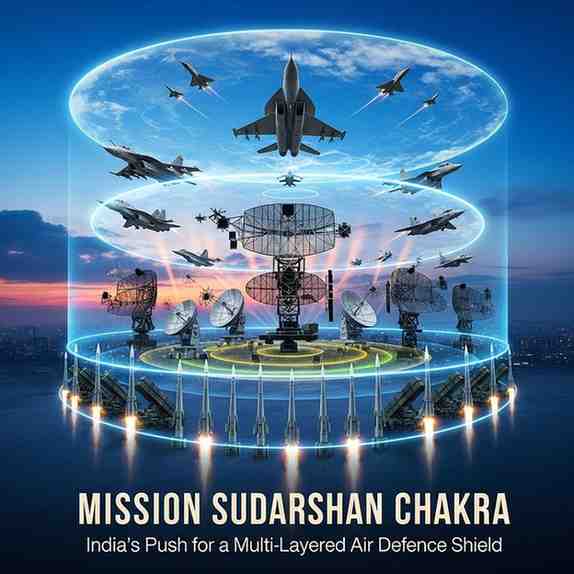
Mission Sudarshan Chakra: India’s Push for a Multi-Layered Air Defence Shield
India has unveiled Mission Sudarshan Chakra , a forward-looking national programme aimed at creating a robust, multi-layered air defence architecture to counter evolving aerial threats, especially hostile drones. The initiative marks a decisive shift in India’s defence strategy as unmanned aerial systems increasingly shape modern conflict scenarios, particularly along sensitive borders with Pakistan .
Growing Drone Threat and Strategic Need
Drones have rapidly emerged as cost-effective yet highly disruptive tools for surveillance, smuggling, and targeted attacks. Global conflicts, including extensive drone deployments in the Russia–Ukraine war and attempts by Pakistan to employ drones during Operation Sindoor , have highlighted how unmanned systems can bypass traditional defences. Indian security agencies have reported a noticeable rise in cross-border drone activity, reinforcing the need for a specialised counter-drone framework beyond conventional air defence mechanisms.
Mission Sudarshan Chakra and Defence Modernisation
Mission Sudarshan Chakra seeks to establish an integrated air defence shield capable of tackling a wide spectrum of threats—from fighter aircraft and missiles to small, low-flying drones. Envisioned with a completion horizon around 2035, the programme complements India’s existing air defence infrastructure, including the Integrated Air Command and Control System . The emphasis is on layered defence, combining long-range interception systems with short-range and point-defence solutions to plug gaps exploited by emerging technologies.
Joint Counter Unmanned Aerial System Grid
In parallel, the Indian Army , Indian Navy , and Indian Air Force are jointly developing a Counter Unmanned Aerial System (CUAS) grid dedicated to neutralising drone threats. This tri-services grid will link sensors, command-and-control centres, and response units across land, sea, and air domains. Joint Air Defence Centres will act as the operational core, enabling real-time intelligence sharing, quicker decision-making, and coordinated responses to drone intrusions targeting borders, coastlines, and critical infrastructure.
Important Facts for Exams
-
Mission Sudarshan Chakra aims to build a multi-layered national air defence shield.
-
Drones are viewed as low-cost but high-impact asymmetric threats .
-
The Joint CUAS grid focuses exclusively on countering unmanned aerial systems.
-
Electronic warfare and directed energy weapons form key components of counter-drone strategy.
Soft-Kill and Hard-Kill Countermeasures
India’s counter-drone approach under Mission Sudarshan Chakra combines both non-kinetic and kinetic solutions. Soft-kill methods rely on electronic warfare tools such as communication interference and GNSS jamming to disrupt or disable drones without destroying them. Hard-kill options include laser-based directed energy weapons, point-defence guns, and other interception systems designed to physically eliminate hostile platforms.
Month: Current Affairs - January 09, 2026
Category: Science and Technology in Defence