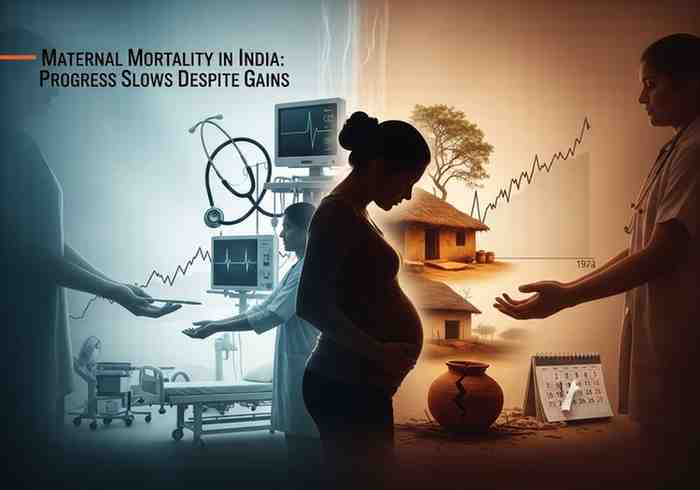
India’s Maternal Health Progress Faces New Challenges
A recent study published in The Lancet highlights that India still contributes a large share of global maternal deaths. Although the country has made strong progress over the years, the pace of improvement has slowed after 2015, raising concerns about future targets.
Global and National Burden
In 2023, around 2.4 lakh women died globally due to pregnancy and childbirth-related causes. India accounted for nearly 24,700 deaths, placing it among the countries with the highest burden. While population size plays a role, it also reflects gaps in maternal healthcare services.
Progress Over Time but Slower Gains
India has achieved a major reduction in maternal deaths over the decades. The number fell from about 1.19 lakh in 1990 to 36,900 in 2015, and further to 24,700 in 2023. The Maternal Mortality Ratio (MMR) also dropped sharply from 508 to 116 per one lakh live births. However, the fastest improvement happened between 2000 and 2015, and progress has slowed since then.
Causes and Regional Differences
Most maternal deaths in India are due to preventable reasons such as heavy bleeding, high blood pressure, infections and complications from existing illnesses. There are also strong regional differences. States like Kerala and Tamil Nadu have achieved better outcomes, while Uttar Pradesh, Bihar and Madhya Pradesh continue to face higher mortality rates due to weaker healthcare access and quality.
Exam-Focused Points
-
MMR: Maternal deaths per 1 lakh live births
-
India’s MMR: 508 (1990) → 116 (2023)
-
Global SDG target: Below 70 MMR by 2030
-
Major causes: Haemorrhage, hypertension, infections
-
Key issue: Regional disparities in healthcare access
Way Forward for Maternal Health
Experts stress the need to strengthen public health systems and improve the quality of care, especially in high-burden states. Better infrastructure, timely treatment and focused policies for vulnerable groups are essential. The disruption caused by COVID-19 also highlights the need for resilient healthcare systems to sustain progress.
Month: Current Affairs - March 30, 2026
Category: Health, Social Issues