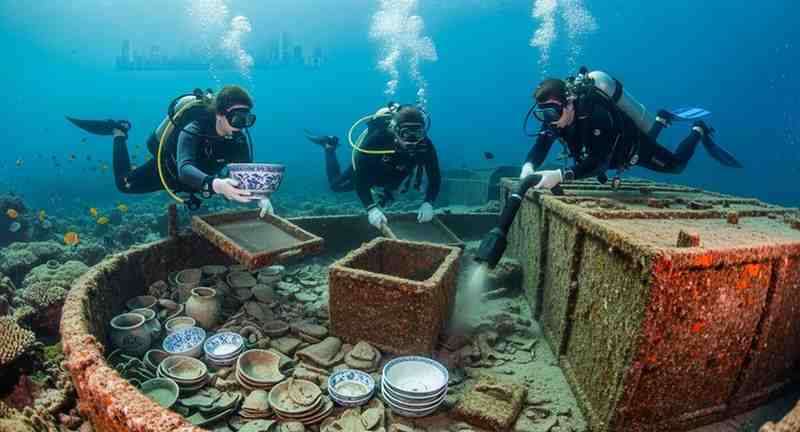
14th-Century Singapore Shipwreck Reveals Yuan Dynasty Porcelain Cargo
A 14th-century shipwreck discovered off the coast of Singapore has uncovered a large cargo of blue-and-white porcelain from the Yuan Dynasty, shedding new light on maritime trade networks during the Mongol period. The vessel, believed to have travelled from China to the historic port of Temasek, sank roughly 650 years ago. Details of the discovery were published in the Journal of International Ceramic Studies in 2025.
Excavation in Difficult Marine Conditions
The exploration was conducted over four years under the leadership of marine archaeologist Michael Flecker from Heritage SG, part of the National Heritage Board. Divers recovered approximately 3.5 metric tonnes of ceramic fragments from the seabed. The work was technically demanding due to powerful currents and extremely low underwater visibility, restricting diving operations to occasional windows of safe conditions.
Among the artefacts recovered, around 136 kilograms consisted of Yuan-era porcelain pieces, some of which were nearly intact. The wooden hull of the ship had largely deteriorated, but researchers believe the vessel was a Chinese junk, a typical ocean-going trading ship used across Asian waters during that period.
Porcelain Motifs and Historical Dating
Several decorative motifs helped scholars estimate the age of the wreck. These included a four-clawed dragon, a phoenix surrounded by chrysanthemum patterns, and mandarin ducks depicted in a lotus pond. The mandarin duck design is associated with the reign of Emperor Wenzong, who ruled from 1328 to 1332 and reportedly reserved this pattern for imperial ceramics.
After his rule ended, the design began appearing in broader commercial production. Considering historical events such as the Red Turban Rebellion and the collapse of the Yuan Dynasty in 1368, researchers estimate the ship likely sank sometime between the late 1320s and 1371.
Maritime Trade and Cultural Exchange
Blue-and-white Yuan porcelain was highly valued across Eurasia for its strength and distinctive design. It was produced in China using cobalt pigment imported from Persia, reflecting early global trade links. The ceramics were transported through maritime routes as well as overland Silk Road networks during Mongol rule.
Historical evidence suggests the cargo may have departed from the Chinese port of Quanzhou and was destined for Temasek, the early settlement located where modern Singapore stands today. Temasek functioned as a prosperous trading hub in the 14th century, attracting merchants from across Asia.
Important Facts for Exams
-
The Yuan Dynasty ruled China from 1271 to 1368 under Mongol leadership.
-
Blue-and-white porcelain used cobalt pigment often imported from Persia.
-
Temasek was the historic name for present-day Singapore.
-
The Red Turban Rebellion played a major role in the fall of the Yuan Dynasty.
The shipwreck offers valuable archaeological evidence of vibrant maritime commerce and cultural interaction across Asia during the Mongol era. It highlights how technological innovation and artistic production in Yuan China supported far-reaching trade networks linking East Asia with the wider world.
Month: Current Affairs - March 04, 2026
Category: Archaeology | Maritime Trade