A steering committee led by the Chief Secretary of Maharashtra.
District-level coordination committees to manage local work.
What Financial Support Does the Policy Offer?
The government wants to attract investors. So it gives several incentives:
| Incentive |
Details |
| Viability Gap Funding (VGF) |
Up to Rs75 lakh per tonne of CBG capacity |
| Maximum VGF per project |
Rs15 crore |
| SGST refund |
2.5% refund on State Goods and Services Tax after production starts |
| Priority services |
Electricity and water supply to CBG units |
Important condition: If a project does not start operations within two years , the land allocation will be cancelled. This keeps projects on track.
How Does This Policy Link to National Programmes?
Maharashtra’s CBG policy supports three major national initiatives:
-
SATAT (Sustainable Alternative Towards Affordable Transportation) – Promotes CBG as transport fuel.
-
GOBARdhan (Galvanising Organic Bio-Agro Resources) – Converts cattle dung and farm waste into biogas.
-
Swachh Bharat Mission – Improves solid waste management across India.
Why Is This Policy Important for India’s Future?
The policy connects waste management with renewable energy. It also helps India reach its Net-Zero target by 2070 . Less waste goes to landfills. Less fossil fuel gets burned. Cleaner air and better farming are added benefits.
FAQ Section
Q1: When was the Maharashtra CBG Policy 2026 approved?
The cabinet approved it on 22 April 2026. The policy was released on 5 May 2026.
Q2: How much money has the government set aside for this policy?
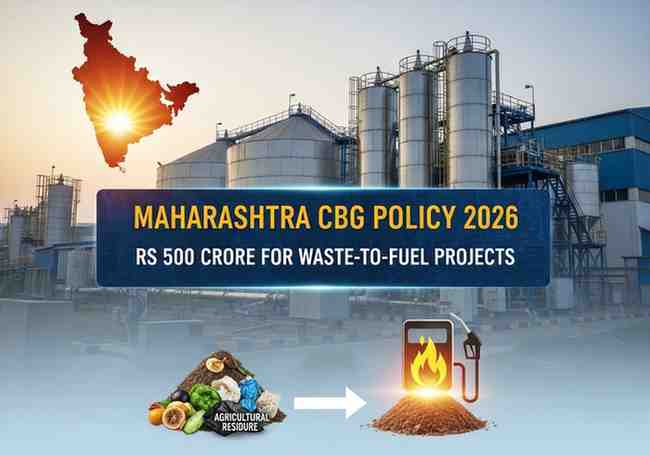
?500 crore for the financial year 2026-27.
Q3: What is the minimum waste processing requirement for one CBG project?
At least 200 tonnes of segregated organic waste per day.
Q4: What is Viability Gap Funding?
It is financial support for infrastructure projects that have a funding gap. The government pays part of the cost to make the project viable.
Q5: What happens if a project does not start in two years?
The land allocation will be cancelled.
Q6: Which national schemes does this policy support?
SATAT, GOBARdhan, and Swachh Bharat Mission.
Q7: How
Month: Current Affairs - May 09, 2026
Category: Environment, Energy