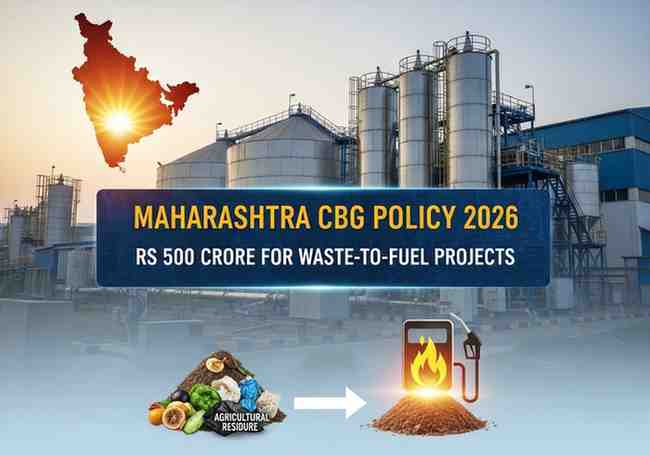
Overview
On 22 April 2026 , the Maharashtra Cabinet approved the Compressed Biogas (CBG) Policy, 2026 . The government officially released it on 5 May 2026 . Chief Minister Devendra Fadnavis led this decision. The policy provides ?500 crore for the financial year 2026-27. It aims to turn organic waste into renewable fuel. The state wants to set up CBG projects in every district.
What Is the Compressed Biogas Policy 2026?
Maharashtra has launched a new policy to promote Compressed Biogas (CBG) . The state cabinet approved it on 22 April 2026 . The official release happened on 5 May 2026 . Chief Minister Devendra Fadnavis heads the government that passed this policy. The state has set aside Rs 500 crore for the year 2026-27 to support this plan.
What Is Compressed Biogas?
Compressed biogas is a renewable fuel . It comes from organic waste. The process has two main steps:
-
Anaerobic digestion – Bacteria break down waste without oxygen. This produces raw biogas.
-
Purification – The raw gas is cleaned to become pure compressed biogas.
CBG works as a fuel for vehicles and industries . It is a clean alternative to petrol and diesel.
Where Does the Waste Come From in Maharashtra?
Maharashtra produces a huge amount of waste every day. The policy uses two types of waste:
| Waste Type |
Amount Generated |
| Municipal solid waste (urban) |
24,500 metric tonnes per day |
| Agricultural residue |
More than 20 million metric tonnes per year |
This waste is currently a problem. The policy turns it into a valuable resource.
How Will the Policy Be Implemented?
The policy has a clear plan. The government wants one CBG project in every district of Maharashtra.
Implementation models:
Key rules for each CBG project:
Who will oversee this?
Month: Current Affairs - May 09, 2026
Category: Environment, Energy