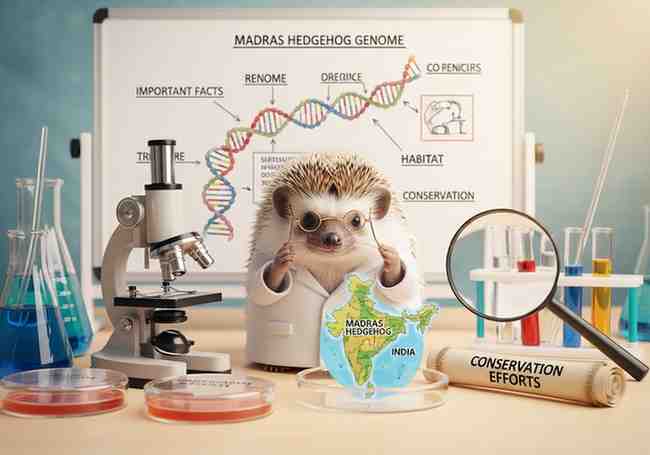
Genomic breakthrough and its importance.
Recent work that has deciphered the entire mitochondrial genome of the Madras hedgehog has revealed new insights into its evolutionary background and genome alterations. The study aids in bridging the gaps of knowledge about the species lineage and resistance, particularly in the dry ecosystems of India. This information is essential in understanding the evolution of species on a molecular scale and in improving conservation efforts.
Of the Madras Hedgehog.
The Madras hedgehog (Paraechinus nudiventris), or Mulleli, is a small, endemic mammal in peninsular India. It was initially reported in 1851, and is widespread in Tamil Nadu, Kerala, Andhra Pradesh and in some areas of Karnataka. The species inhabits dry scrublands, thorn forests, grasslands and even agricultural fringes showing its adaptability to dry semi-arid environment.
Physical Characteristics and Behaviour.
This hedgehog is described as spiny on the back and soft and pale on the underside. The spines safeguard against predators such as foxes and jackals. It is chiefly nocturnal, and follows a defensive mode of winding up to a ball when in danger. Its high ecological adaptations are reflected in its survival in harsh and dry environments. It normally lives about five to six years.
Diet and Ecological Importance
It is primarily insectivorous and preys on beetles, ants, termites and earthworms, as well as on occasional plant food. By controlling insect populations and aiding soil aeration, the Madras hedgehog plays an important ecological role. It plays a supportive role in biodiversity and agricultural balance on the dry landscapes.
Exam-Focused Key Points
- Peninsular Indian endemic.
- Latin name: Paraechinus nudiventris.
- Location: dry scrublands, grasslands, thorn forests.
- Behaviour: nocturnal; defensive curling mechanism.
- Diet: primarily insectivorous.
- IUCN Status: Least Concern.
Threats and Conservation Concerns.
Although it has the Least Concern status, the species is threatened locally. The traditional beliefs regarding medicinal value and continuing degradation of habitat by agricultural expansion are some of the major concerns that lead to hunting. Further scientific research, such as genetic research, is needed to help in making informed conservation plans and protection of species on the long term.
Month: Current Affairs - April 08, 2026
Category: Environment | Biodiversity