Overview :
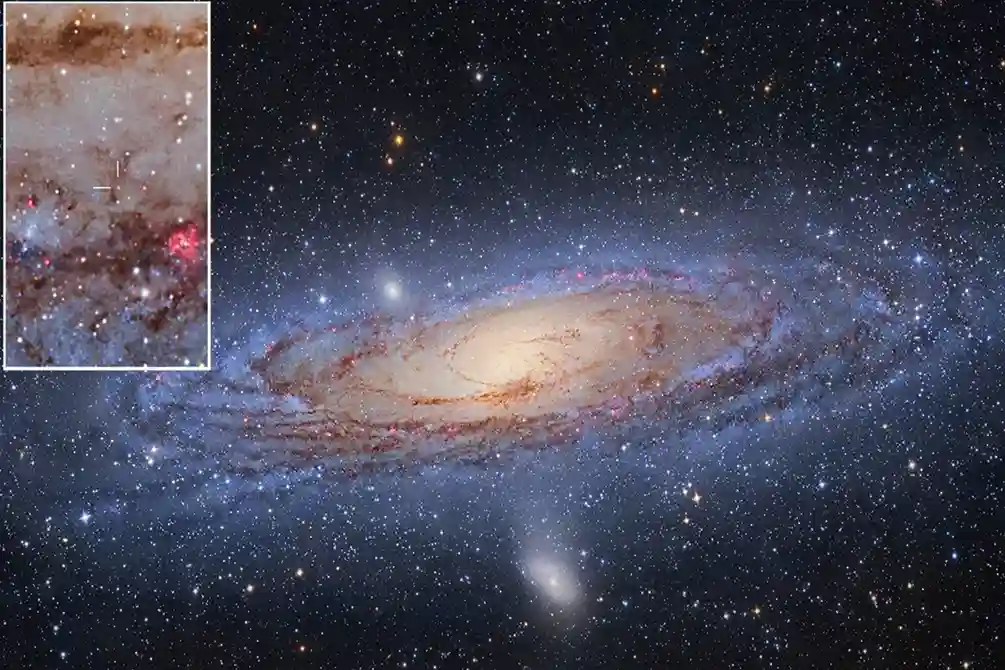
Learn how Edwin Hubble’s study of M31-V1, a Cepheid star in Andromeda, helped prove that our universe contains galaxies beyond the Milky Way.
M31-V1: The Star That Changed
On the night of October 5–6, 1923 , American astronomer Edwin Hubble made observations of a star in the Andromeda region. He identified M31-V1 , a Cepheid variable star. Its distance helped show that Andromeda lies far beyond the Milky Way.
What Is M31-V1?
M31-V1 is a Cepheid variable star in the Andromeda galaxy. Cepheid stars change their brightness in a regular pattern. Astronomers can use this change like a cosmic measuring tool to estimate great distances in space.
Hubble’s Important Observation
Hubble observed M31-V1 and studied its changing brightness. He used the star to estimate the distance to Andromeda. His work showed that Andromeda could not be a small cloud inside the Milky Way.
The Great Debate
In the early 1920s, astronomers had a major debate. Some believed that the Milky Way contained almost everything in the universe. Others believed that objects such as Andromeda were separate galaxies located very far away.
How M31-V1 Changed Astronomy
M31-V1 provided strong evidence that Andromeda was a separate galaxy. This finding greatly expanded our understanding of the universe. It showed that the Milky Way was only one galaxy among many.
Why Cepheid Stars Matter
Cepheid variables have a useful link between their brightness and pulsation period. Astronomers can use this relationship to estimate distance. That makes Cepheids important tools for studying nearby galaxies.
Edwin Hubble’s Contribution
Edwin Hubble became one of the key astronomers in modern astronomy. His observations helped scientists understand that the universe contains many galaxies. His work also supported later studies of the expanding universe.
Exam-Focused Points :
-
M31-V1 is a Cepheid variable star in the Andromeda galaxy.
-
Edwin Hubble observed M31-V1 in 1923 .
-
Hubble used the star to estimate the distance to Andromeda.
-
The observation showed that Andromeda is a separate galaxy .
-
Cepheid variables help astronomers measure cosmic distances .
-
The discovery helped end the major debate about the nature of spiral nebulae .
-
Hubble’s work greatly expanded our understanding of the scale of the universe .
FAQs :
1. What is M31-V1?
M31-V1 is a Cepheid variable star located in the Andromeda galaxy.
2. Who discovered M31-V1?
American astronomer Edwin Hubble identified and studied the star in 1923.
3. Why is M31-V1 important?
It helped show that Andromeda lies outside the Milky Way.
4. What is a Cepheid variable?
It is a star whose brightness changes in a regular pattern. Astronomers use these changes to estimate distance.
5. What did Hubble’s observation prove?
It provided evidence that Andromeda is a separate galaxy and that the universe is much larger than the Milky Way.
Month: Current Affairs - Oct 05, 2026
Category: Andromeda Galaxy