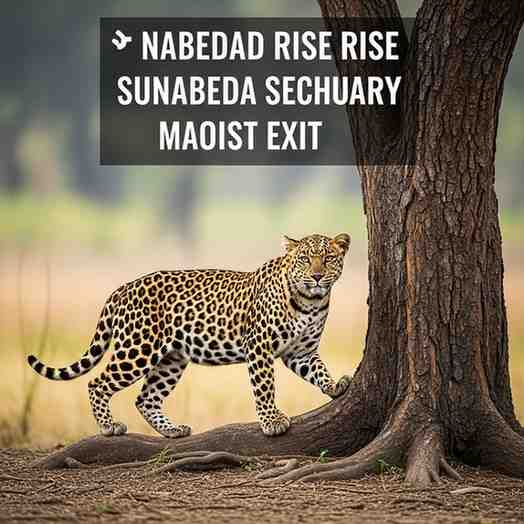
Leopard Presence Grows in Maoist-Free Sunabeda Sanctuary
Sunabeda Wildlife Sanctuary in western Odisha is showing encouraging signs of ecological recovery, with forest officials reporting a sharp rise in leopard presence. The development follows the declaration of the sanctuary as Maoist-free, enabling full-scale wildlife monitoring in an area that remained largely inaccessible for years due to Left-wing extremism.
Spread over nearly 600 square kilometres in Nuapada district, Sunabeda is also a proposed tiger reserve and forms part of a larger forested landscape linking Odisha with neighbouring Chhattisgarh.
Camera Traps Reveal Strong Leopard Activity
During the most recent all-India tiger estimation exercise, forest staff recorded widespread leopard movement across the sanctuary. Though official census data is still awaited, internal assessments suggest that more than 70 leopards may be using the forest. Officials noted that close to 90 per cent of camera traps installed across Sunabeda captured leopard images or indirect signs such as pugmarks, indicating a well-established population.
Frequent reports of human–leopard interactions from nearby villages further point to the species’ strong presence and adaptability in the region.
Security Improvements Enable Scientific Monitoring
Forest officers say that the absence of Maoist activity has been crucial to this improved assessment. In the past, large tracts of Sunabeda remained off-limits, with camera traps often damaged or removed and patrols restricted due to security threats. Nearly half the sanctuary had been under Maoist influence for over a decade.
With the area now accessible, wildlife teams were able to deploy camera traps systematically across all ranges, allowing for more reliable data on carnivores, prey species and habitat use.
Healthy Prey Base Supports Big Cats
According to Divisional Forest Officer Sameer Sahu, better protection and habitat management have resulted in rising prey density. Sunabeda supports a diverse assemblage of herbivores, including deer, chowsingha, wild boar and gaur (bison). This abundance of prey, combined with reduced human disturbance, has created favourable conditions for large carnivores, particularly leopards, which are known for thriving in mixed forest landscapes.
Important Facts for Exams
-
Sunabeda Wildlife Sanctuary is located in Nuapada district of Odisha
-
The sanctuary covers around 600 sq km and is a proposed tiger reserve
-
Leopards are highly adaptable predators requiring adequate prey density
-
Maoist activity had earlier restricted conservation and monitoring efforts
Tiger Conservation Prospects Ahead
Sunabeda’s tiger status has fluctuated in recent years. While a 2016 state census recorded four tigers, the latest national assessment released in July last year did not report any resident tigers. Conservationists believe prolonged Maoist presence since 2009 weakened protection infrastructure and disrupted wildlife management.
With improved security and ecological connectivity to Udanti Wildlife Sanctuary, experts are hopeful that the current tiger census may reflect gradual recovery. The resurgence of leopards is being seen as an early indicator of a strengthening ecosystem and renewed potential for large carnivore conservation in the region.
Month: Current Affairs - February 01, 2026
Category: Wildlife Conservation | Internal Security