Overview
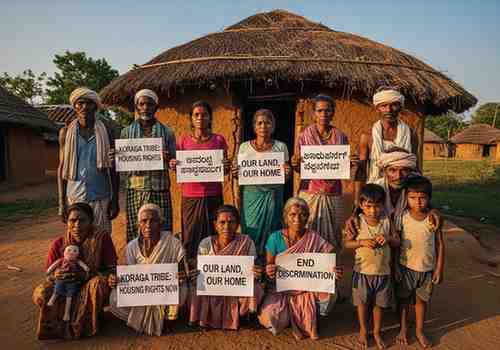
The Koraga tribe is a Particularly Vulnerable Tribal Group found mainly in Karnataka and Kerala. They speak Koraga Bhasha and follow a matrilineal family system. The UN-Habitat World Cities Report 2026 highlighted their housing struggles as an example of deep inequality caused by caste barriers and policy gaps.
A Community in Need of Attention
The Koraga tribe is one of India’s most vulnerable indigenous communities. They live mostly in the coastal districts of Karnataka and Kerala. Despite being citizens of a rapidly growing country, they face many problems. The biggest problem is housing. Many Koraga families do not have proper homes. They live in makeshift huts or on the edges of villages. The UN-Habitat World Cities Report 2026 recently highlighted their plight. The report said that caste barriers and policy gaps keep many communities like the Koraga from getting secure housing. This article tells you everything about the Koraga tribe – who they are, where they live, how they live, and what challenges they face.
Where Do the Koraga Tribe Live?
The Koraga tribe is mainly found in three districts. In Karnataka, they live in Dakshina Kannada and Udupi districts. In Kerala, they live in Kasaragod district. Small numbers of Koraga people can also be found in almost all other districts of Karnataka. They prefer to live near forests and agricultural lands. Traditionally, they were forest dwellers. But with forests shrinking, many have moved to the outskirts of towns and villages. They still remain on the margins of society – both socially and geographically.
A Particularly Vulnerable Tribal Group (PVTG)
The Government of India classifies the Koraga tribe as a Particularly Vulnerable Tribal Group (PVTG). This is a special category for tribal communities that are small in number, have low literacy rates, and are at risk of disappearing. PVTGs get extra help from the government. But despite this, the Koraga continue to suffer from poverty, ill health, and social discrimination. The housing problem is just one part of a much bigger struggle.
Language: Koraga Bhasha and Tulu
The Koraga people have their own language. It is called Koraga Bhasha. It belongs to the Dravidian family of languages. Many Koragas also speak Tulu, which is the local language of the coastal region. Some also speak Kannada or Malayalam to talk to outsiders. But within their community, they prefer Koraga Bhasha. Unfortunately, the language is now spoken by very few people. Younger Koragas are switching to Tulu or Kannada. This is a sign that their unique culture is slowly fading away.
Economy and Livelihood
The Koraga tribe traditionally depends on agriculture and forest resources. Many work as daily labourers on farms. They plant, weed, and harvest crops for landowners. Some collect firewood, honey, and wild fruits from the forest. But forests are shrinking, and farm work is not available all year. So many Koragas have turned to traditional crafts. The most famous craft is basket-making. Koraga baskets are strong and beautifully woven. They sell these baskets in local markets. But the income is very small. A family may earn just a few hundred rupees a day. This is not enough to build a proper house or send children to good schools.
Matrilineal Family System
One of the most interesting things about the Koraga tribe is their family system. They follow a matrilineal system. This means that family lineage is traced through the mother. Property and family
Month: Current Affairs - May 27, 2026
Category: Tribal Communities, Social Justice