Overview :
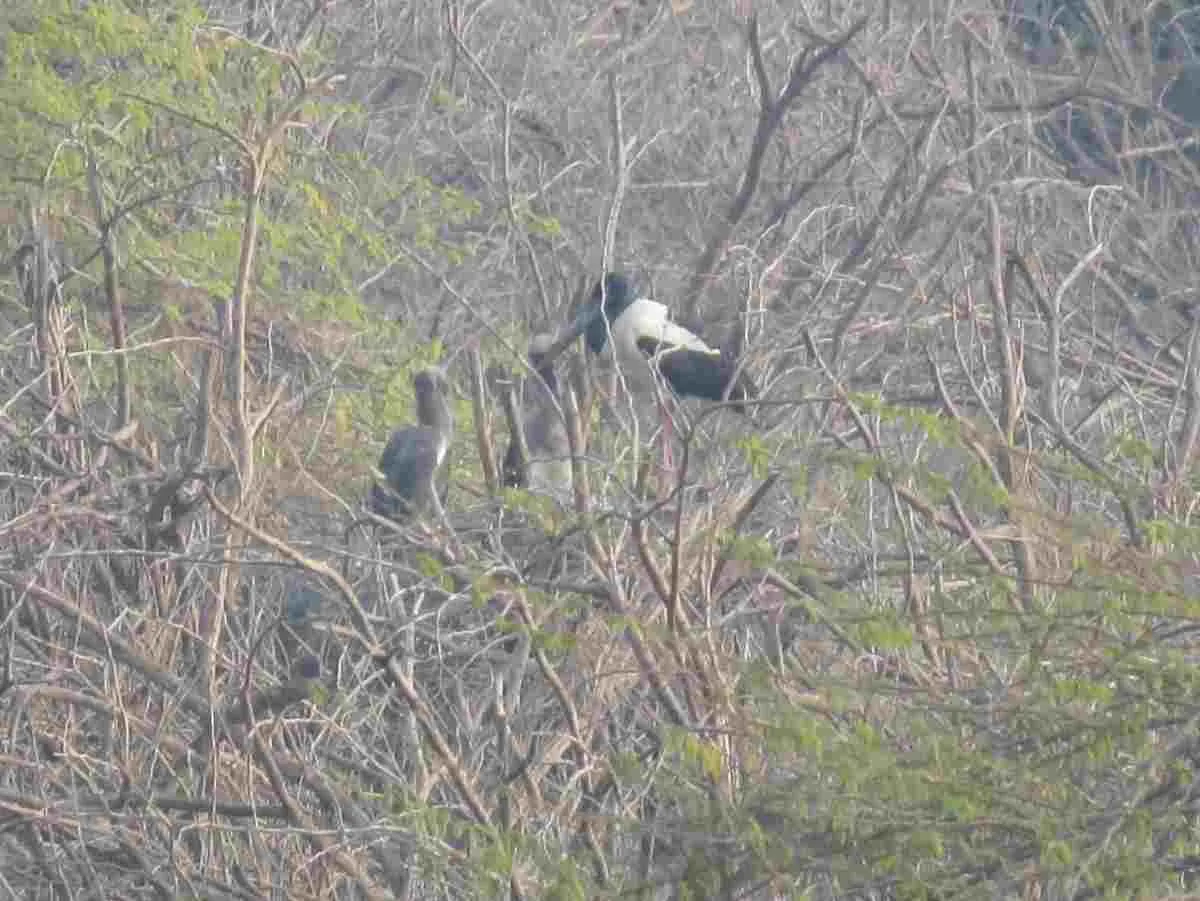
Researchers identified Khijadiya Bird Sanctuary as a major breeding site for the Black-necked Stork. Four nests produced eight fledglings, all built on the invasive Neltuma juliflora tree. The study highlights the importance of Gujarat's wetlands for this near-threatened species.
Khijadiya Bird Sanctuary
It is a Ramsar site in Gujarat's Jamnagar district. It is known for its freshwater and brackish-water wetlands, with eight management zones. It supports a wide range of resident and migratory birds.
The Black-Necked Stork
This large wading bird is found in South and Southeast Asia. It is near-threatened due to habitat loss and wetland degradation. Its presence in Khijadiya underscores the sanctuary's conservation value.
Nesting on an Invasive Tree
The storks built their nests on the invasive Neltuma juliflora (gando baval). This indicates that even invasive species can play a role in supporting native wildlife.
Breeding Success
The study recorded 100% breeding success—all four nests produced two chicks each. This is a positive sign for the species.
Biparental Care
Both parents participated in nest care. In 94% of observations, partner replacement occurred during foraging departures.
Significance
This study provides important insights into the nesting ecology of the Black-necked Stork.
Exam-Focused Points :
-
Location Khijadiya Bird Sanctuary, Jamnagar, Gujarat (Ramsar site).
-
Study Conducted by GEER Foundation (July 2024–March 2025) over 48 sampling points.
-
Species Black-necked Stork ( Ephippiorhynchus asiaticus ) – family Ciconiidae.
-
Population Peak of 21–23 birds, including breeding pairs, non-breeders, and juveniles.
-
Nesting 4 active nests (October–December), all built on Neltuma juliflora (gando baval).
-
Success 100% breeding success – 8 fledglings produced.
-
Biparental Care Both parents participated in nest care in 94% of observed instances.
FAQs :
Q1: Which bird species was studied?
The Black-necked Stork ( Ephippiorhynchus asiaticus ).
Q2: Where is the Khijadiya Bird Sanctuary?
Jamnagar district, Gujarat.
Q3: What tree did the storks use for nesting?
Neltuma juliflora (gando baval), an invasive species.
Q4: How many fledglings were produced?
8 fledglings from 4 nests.
Q5: Which organisation conducted the study?
Gujarat Ecological Education and Research (GEER) Foundation.
Month: Current Affairs - Aug 25, 2026
Category: Ramsar Site