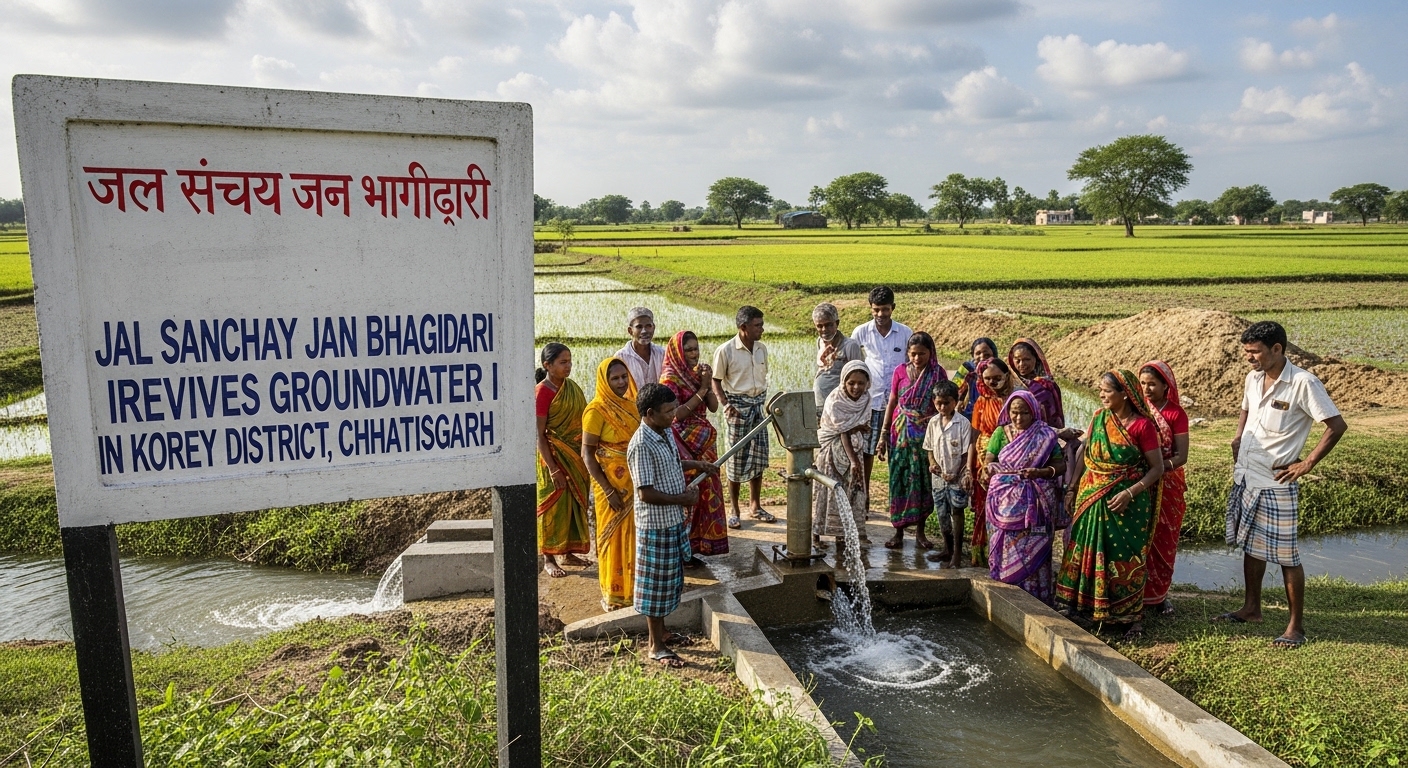
Community-Led Water Conservation Model Emerges in Korea District, Chhattisgarh
Korea District Chhattisgarh has emerged as a significant example of community-driven water conservation through the Jal Sanchay Jan Bhagidari initiative. The programme encourages farmers to voluntarily dedicate a small share of their farmland to structures designed for groundwater recharge and rainwater conservation. The campaign operates under the Aawa Paani Jhoki movement and emphasises participatory approaches to ensure long-term water sustainability in rural communities.
Farm-Based Groundwater Recharge Model
Under the initiative, farmers allocate around five per cent of their agricultural land to construct small recharge ponds and terraced pits. These structures capture rainwater during the monsoon season and gradually allow it to seep into the soil, replenishing underground water reserves.
By reducing surface runoff during heavy rainfall, these structures improve groundwater infiltration and enhance soil moisture levels. This approach not only prevents soil erosion but also ensures improved water availability for crops during dry periods, supporting sustainable agricultural practices.
Role of Community Participation
The success of the initiative is largely attributed to strong community involvement. Women leaders in the villages, called ‘Neer Nayikas’ , play a central role in promoting water conservation practices and guiding households in constructing soak pits for rainwater recharge.
Young volunteers known as ‘Jal Doots’ assist in mapping trenches, cleaning canals and spreading awareness through community outreach activities such as street plays and wall paintings. The programme demonstrates how coordinated efforts between local residents, farmers and administrative authorities can address water scarcity effectively.
Revival of Traditional Water Bodies
The campaign also focuses on restoring traditional water sources. Local communities have collectively revived over 440 traditional ponds through voluntary labour and community mobilisation.
In addition, more than 500 beneficiaries of Pradhan Mantri Awas Yojana constructed soak pits near their homes, integrating water conservation practices into residential spaces. Scientific tools such as micro-watershed mapping and hydrogeological surveys were used to identify suitable sites for recharge structures.
Important Facts for Exams
-
Jal Sanchay Jan Bhagidari is a community-led water conservation programme in Korea district, Chhattisgarh.
-
Farmers dedicate 5% of agricultural land for groundwater recharge structures.
-
Neer Nayikas are women volunteers promoting water conservation practices.
-
Jal Doots are youth volunteers assisting with awareness and field activities.
Impact on Water Security and Livelihoods
The initiative has significantly improved water availability in several villages. Groundwater levels have reportedly increased by three to four metres in some areas, while natural springs have revived in 17 remote tribal settlements .
Enhanced soil moisture has improved agricultural productivity and strengthened rural livelihoods. Officials also report a 25 per cent reduction in seasonal migration , indicating that improved water management has created greater economic stability in the region. The programme demonstrates how scientific planning combined with community participation can deliver sustainable solutions to water scarcity.
Month: Current Affairs - March 06, 2026
Category: Environment | Water Conservation