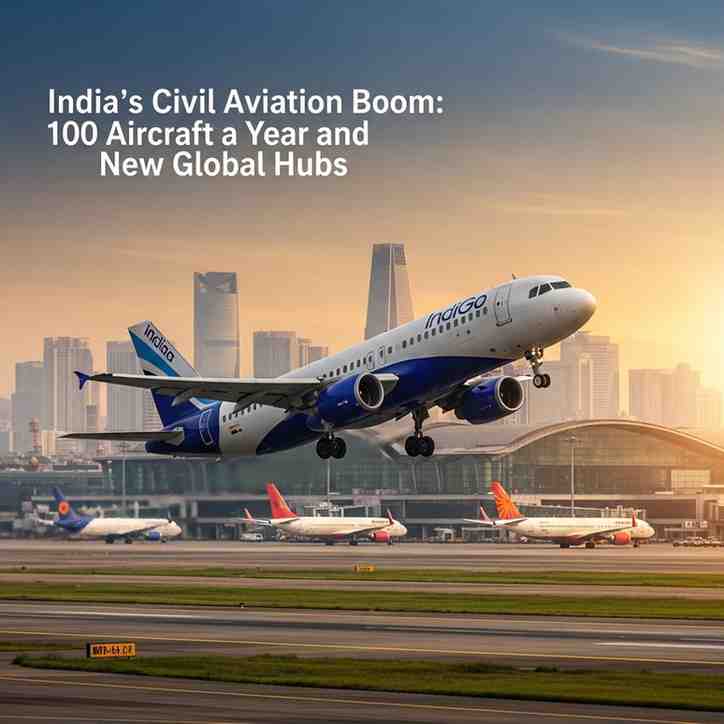
India’s Civil Aviation Expansion Targets Global Hub Status
India’s civil aviation sector is entering a high-growth phase , with the Union Government projecting sustained aircraft induction by domestic airlines over the next decade. The expansion is being driven by large aircraft orders, new airport infrastructure, and a strategic push to reduce India’s dependence on foreign transit hubs by strengthening direct international connectivity from Indian cities.
Fleet Growth Signals Long-Term Capacity Surge
Union Civil Aviation Minister Ram Mohan Naidu stated that Indian carriers are expected to induct around 100 aircraft annually for the next 10–15 years , reflecting long-term capacity planning. India’s current commercial fleet stands at 843 aircraft .
In 2025 , domestic airlines inducted 80 aircraft , while about 106 planes are expected in 2026 . The projected growth is backed by large existing orders and expansion plans of major carriers such as Air India , IndiGo , Akasa Air , and regional operator Star Air .
New Airports and Direct Connectivity Strategy
The government is shifting focus from merely expanding bilateral air service agreements to enabling Indian airports and airlines to realise their full hub potential . Upcoming mega airports are being positioned to support direct hub-to-hub international flying , allowing Indian carriers to operate long-haul routes without relying on foreign transfer points.
This strategy also aims to attract passengers from neighbouring countries to connect through Indian airports, while consolidating traffic from Indian cities into emerging domestic global hubs.
Reclaiming Traffic from Foreign Transit Hubs
Historically, a large share of India’s international passenger traffic has flowed through hubs such as Dubai, Doha, Singapore, Colombo, and European gateways. According to the minister, aviation policy since 2014 has focused on reclaiming this traffic for Indian airlines and airports.
However, a key constraint remains the limited wide-body fleet of Indian carriers. While global competitors operate large numbers of long-haul aircraft, Indian airlines are only now scaling up wide-body operations, though significant deliveries are on order.
Bhogapuram Airport and New Focus Regions
The minister was speaking at Bhogapuram Airport after it received its first commercial validation flight by Air India , ahead of its expected operational launch this summer. He identified the Global South and Africa as priority regions for expanding direct air links, while noting that some key routes are already operating at full capacity under existing bilateral limits.
Important Facts for Exams 📌
-
India’s commercial fleet size: 843 aircraft
-
Aircraft inducted in 2025: 80
-
Expected inductions in 2026: ~106 aircraft
-
Wide-body aircraft are essential for non-stop long-haul connectivity
-
Bilateral Air Service Agreements govern international seat entitlements
Month: Current Affairs - January 06, 2026
Category: Airport Expansion