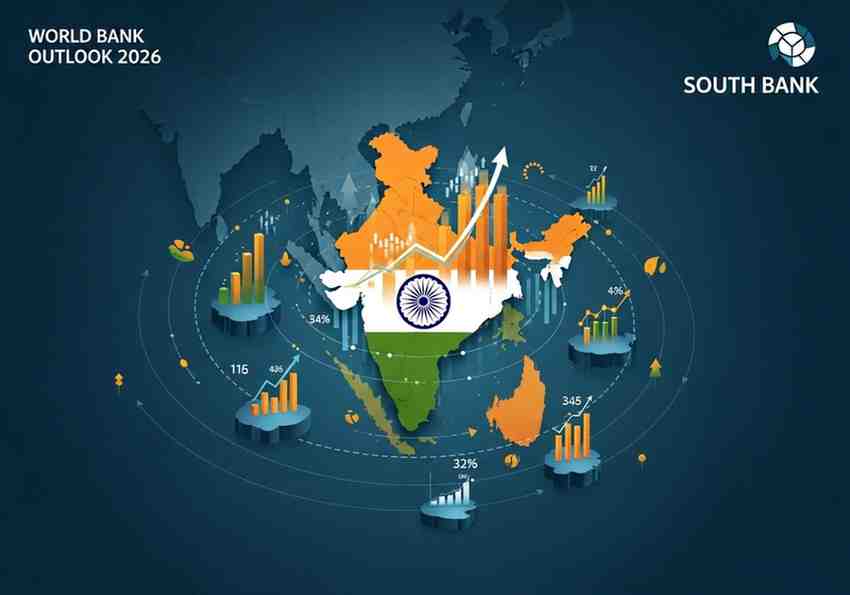
India holds the South Asian Economic Growth at Ransom.
The last regional forecast on economic growth by the World Bank (April 2026) revealed that India will continue to be the engine of economic growth in South Asia. Although the world is facing some uncertainties and decelerating growth in neighbouring economies, the robust domestic fundamentals in India are expected to support regional growth.
Prospects and Stability.
Report estimates that the GDP growth in India rose to 7.6% in FY26 as compared to 7.1% in FY25. In future, the growth is estimated to be 6.6% in FY27, a little higher than the previous forecasts. This steady performance makes India the fastest growing major economy in the region and a major contributor to the overall output of South Asia.
Growth Motivators: Exports and Consumption.
Strong domestic consumption remains a key strength of the Indian economy. The improved purchasing power and demand is a result of low inflation and recent GST rationalisation. Meanwhile, the consistent results in exports have offset economic forces in the world allowing the economy to sustain the balance in the face of external forces.
External Threats and Local Deceleration.
According to the report, geopolitical tensions in West Asia are an important risk factor. Inflation may be contributed by the increase in energy prices and supply chain breakdowns, which may impact the economic stability. With most South Asian nations being the major recipients of energy imports, the growth of the region is projected to slow down to 6.3% in 2026 compared to 7% in 2025.
Exam-Focused Key Points
- The biggest contributor to the growth of South Asia GDP is India.
- South Asia Economic Updates are published by World Bank.
- Growth: 7.6% (FY26), projected 6.6% (FY27).
- Among the growth drivers are consumption and exports.
- The inflation and growth of the regions are affected by energy price shocks.
Concerns and Future Outlook of Inflation.
Although the domestic demand is doing very well, it could push the inflation upwards in the short term. Even though consumption is facilitated by policy interventions such as GST reforms, the bigger picture is unclear because of the global geopolitical shifts. The FY27 growth estimates are between 5.9-6.7 indicating external risks and economic instability.
Month: Current Affairs - April 09, 2026
Category: Global Economic Trends