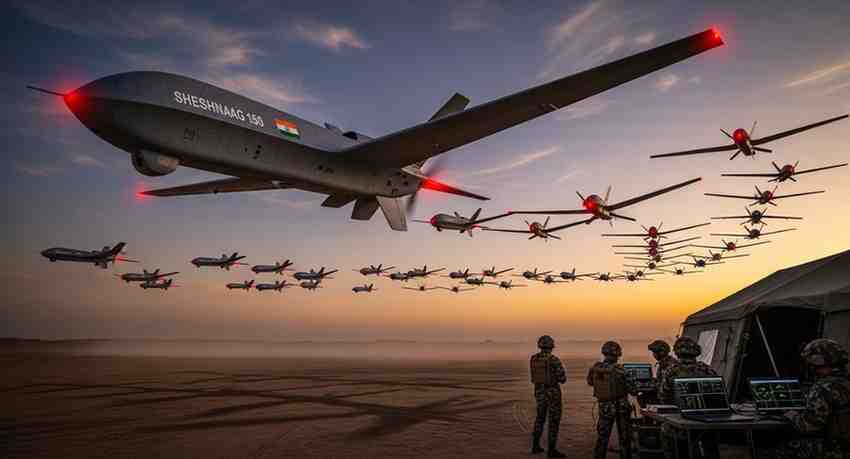
Indigenous Sheshnaag-150 Drone Strengthens India’s Unmanned Warfare Capability
India is strengthening its unmanned combat capabilities with the development of the Sheshnaag-150 , a long-range swarming attack drone currently undergoing testing. The platform has been developed by Bengaluru-based defence startup Newspace Research Technologies and is part of India’s broader push toward indigenous unmanned warfare systems. The drone reportedly completed its maiden test flight about a year ago and is being evaluated as part of the country’s evolving military strategy involving autonomous aerial platforms.
Rising Role of Low-Cost Combat Drones
Recent conflicts around the world have highlighted the effectiveness of low-cost attack drones in modern warfare. Platforms such as the Shahed-136 and the LUCAS demonstrate how relatively inexpensive unmanned systems can strike infrastructure, military vehicles and logistics networks with precision.
These drones allow armed forces to conduct targeted operations without relying solely on expensive aircraft or missile systems. The Sheshnaag-150 aims to replicate similar capabilities through indigenous design and swarm-based operational tactics .
Development Momentum After Operation Sindoor
The Sheshnaag programme reportedly accelerated following Operation Sindoor , when the Indian military emphasised the need for rapid deployment of long-range unmanned strike systems. Defence planners sought faster development of indigenous swarm drone technology capable of supporting surveillance and precision attack missions in operational theatres.
Key Capabilities of Sheshnaag-150
The Sheshnaag-150 has been designed to operate as part of a coordinated swarm , where multiple drones function together to overwhelm enemy air defence systems. The drone is expected to have an operational range exceeding 1,000 kilometres and an endurance of over five hours , enabling it to conduct extended surveillance and loitering missions.
Each unit can reportedly carry warheads weighing between 25 kg and 40 kg , allowing it to strike military installations, infrastructure or logistics targets. The system also incorporates a high degree of automation , enabling drones to detect and track targets with minimal human intervention.
Advanced Control and Navigation Systems
A major technological component of the system is its proprietary control software , which coordinates multiple drones simultaneously. This architecture allows several drone variants to operate under a shared command framework.
Future versions are expected to integrate visual navigation technology , enabling drones to operate even when satellite navigation signals are jammed , a common challenge in modern electronic warfare environments.
Exam-Focused Points
-
Sheshnaag-150 is a long-range swarming attack drone developed by Newspace Research Technologies.
-
The drone has an operational range of over 1,000 km and endurance of more than five hours .
-
Each drone can carry 25–40 kg warheads for strike missions.
-
Swarm drone technology involves multiple UAVs coordinating using shared algorithms and communication systems.
-
Indigenous defence technologies are promoted under the Atmanirbhar Bharat initiative .
Month: Current Affairs - March 12, 2026
Category: Defence Technology / Unmanned Warfare