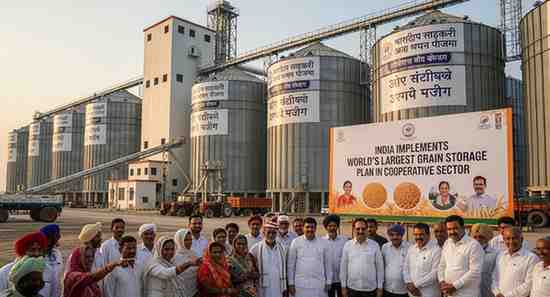
PACS-Based Storage Infrastructure Expanded Under National Grain Storage Initiative
The Government of India is implementing the World’s Largest Grain Storage Plan in the Cooperative Sector to expand rural storage infrastructure and improve foodgrain management. The initiative focuses on establishing modern storage facilities through Primary Agricultural Credit Societies (PACS) and other cooperative bodies. The programme aims to minimise post-harvest losses, improve farmers’ access to storage facilities and strengthen the efficiency of the agricultural supply chain.
Selection Criteria for PACS
Under the initiative, PACS are chosen according to specific financial and operational requirements. The societies must first be identified and approved by District Cooperative Development Committees (DCDC) . Priority is given to regions where agencies such as the Food Corporation of India (FCI) , National Agricultural Cooperative Marketing Federation of India (NAFED) and National Cooperative Consumers’ Federation of India (NCCF) have identified storage gaps or strong demand for warehouses.
Additionally, eligible PACS must demonstrate financial stability by maintaining positive net worth during the previous two financial years , avoiding bank defaults and reporting profits for at least three consecutive years . Proposed storage units are expected to have a minimum capacity of around 500 metric tonnes .
Convergence of Government Schemes
The storage plan integrates several central government programmes to create a comprehensive support framework. These include the Agriculture Infrastructure Fund (AIF) , the Agricultural Marketing Infrastructure Scheme (AMI) , the Sub Mission on Agricultural Mechanization (SMAM) and the Pradhan Mantri Formalisation of Micro Food Processing Enterprises Scheme (PMFME) .
Through this convergence approach, cooperatives receive financial assistance and technical support to develop storage facilities and strengthen agricultural logistics networks.
Financial Assistance and Subsidy Support
Under the Agriculture Infrastructure Fund , PACS receive interest subvention on loans taken for building storage infrastructure. The Agricultural Marketing Infrastructure Scheme provides a 33% subsidy for constructing foodgrain warehouses.
The National Bank for Agriculture and Rural Development (NABARD) functions as the subsidy channelising agency and is responsible for approving and releasing financial support for these projects.
Role of Cooperative Banks
Financing for the initiative is mainly provided by State Cooperative Banks and District Central Cooperative Banks , which sanction and disburse loans to PACS within specified timelines. The programme also benefits from NABARD’s refinance schemes , which reduce borrowing costs for cooperative institutions.
Combined with the three percent interest subvention under AIF , the effective interest rate on loans for PACS can drop to around one percent . Some states, including Rajasthan and Gujarat , have introduced additional incentives to support warehouse construction under their own programmes.
Exam-Focused Points
-
Primary Agricultural Credit Societies (PACS) provide credit and agricultural services to farmers at the village level.
-
The Agriculture Infrastructure Fund supports development of post-harvest infrastructure.
-
The National Bank for Agriculture and Rural Development (NABARD)
Month: Current Affairs - March 13, 2026
Category: Agriculture & Rural Development