Overview :
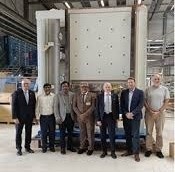
India developed and delivered the first indigenously built beam catcher for the Facility for Antiproton and Ion Research (FAIR) in Darmstadt, Germany, on August 7, 2026. CSIR-CMERI designed the 40-tonne system, which will be installed in the Super Fragment Separator. India is the only non-European shareholder in FAIR.
Understanding FAIR
Think of FAIR as a microscope for particles. It uses high-energy ion beams to study matter under extreme conditions—like those found in neutron stars or supernovae. The facility helps scientists understand the fundamental building blocks of the universe.
The Beam Catcher's Role
The beam catcher acts like a brake pad for high-energy particle beams. It absorbs the remnants of heavy-ion beams, preventing them from causing damage downstream. This allows scientists to produce radioactive beams for research purposes.
Why India's Contribution Matters
India is the only non-European shareholder in FAIR GmbH. This positions India as a key partner in cutting-edge nuclear physics research. The indigenous design and manufacture of the beam catcher showcase Indian scientific and engineering capabilities.
The Indian Institutions
-
CSIR-CMERI An autonomous research institute under the Ministry of Science and Technology, known for mechanical and industrial engineering research.
-
Bose Institute A premier research institute in Kolkata, serving as the nodal Indian institution for FAIR.
The Manufacturing Connection
Trident Auto Components in Kanpur manufactured the beam catcher. This demonstrates how India's automotive component industry can contribute to high-precision scientific equipment manufacturing.
Funding Partnership
The 50:50 sharing pattern between DST and DAE reflects the interdisciplinary nature of the project—combining basic science (DST) and nuclear energy research (DAE).
Exam-Focused Points :
-
Project Facility for Antiproton and Ion Research (FAIR)—international accelerator-based facility in Darmstadt, Germany
-
Indian contribution Beam catcher designed by CSIR-CMERI, Durgapur; manufactured in Kanpur
-
First unit arrived August 7, 2026, for installation in Super Fragment Separator (super-FRS)
-
Weight ~40 tonnes with shielding plates; contains graphite and hyper-pure copper absorbers
-
Energy absorption ~29 kJ in 50-100 nanosecond pulses; peak energy density up to 300 J/g
-
Indian institutions Bose Institute, Kolkata (primary coordinator, nodal institution, shareholder); CSIR-CMERI (designer)
-
Funding DST and DAE (50:50 sharing); India is the only non-European shareholder in FAIR GmbH
FAQs :
Q1: What is FAIR?
An international accelerator-based research facility for nuclear and particle physics located in Darmstadt, Germany.
Q2: What is the beam catcher?
A critical component of the super-FRS that absorbs heavy-ion beam remnants and helps produce radioactive beams for research.
Q3: Which Indian institutions are involved?
CSIR-CMERI, Durgapur (designer); Bose Institute, Kolkata (coordinator and shareholder); Trident Auto Components, Kanpur (manufacturer).
Q4: How did India become associated with FAIR?
India signed an international convention on October 4, 2010, in Wiesbaden, Germany, becoming a founding member.
Q5: What is India's funding share?
Equal funding from the Department of Science and Technology (DST) and the Department of Atomic Energy (DAE)—50:50 sharing.
Month: Current Affairs - Aug 08, 2026
Category: Science and Technology