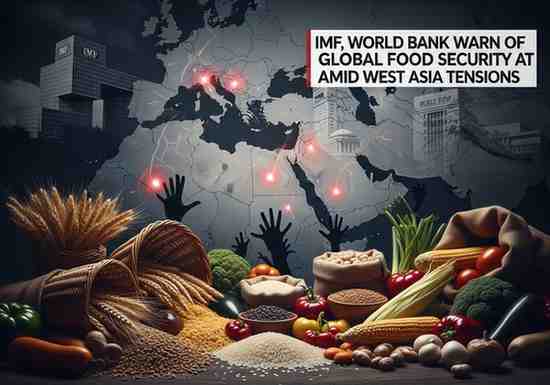
Increasing World Food Security Issues.
The major international organizations, such as the International Monetary Fund, World Bank, and the World Food Programme have cautioned of a possible increase in food insecurity as a result of growing geopolitical tensions in West Asia. On April 9, 2026, in a joint statement, they emphasized the way energy market disturbances are already starting to impact food systems worldwide.
Food Price Inflation, Energy Shocks.
The institutions observed that an increase in the cost of oil, natural gas as well as fertilisers is directly increasing the cost of food. Energy is a very important factor in agriculture, in the production of fertilisers as well as the process of irrigation, transportation, and storage. The higher the price of fuel, the higher the cost of production and distribution of food and this is adding to world food inflation.
Weak Economies at an Increased Risk.
The most affected countries are low-income and those that rely on imports. These countries are also very dependent on imported fuel and fertilisers hence they are very vulnerable to external price shock. Others are already saddled with big debt and low fiscal capacity which makes it hard to shield the vulnerable populations to the increasing food prices.
Geopolitical Tension and World Effect.
The current war in West Asia has interfered with energy chains and brought about unpredictability in the global markets. Despite the temporary tensions between the United States and Iran, as well as between the United States and Iran, the instability remains. This is one of the biggest disruptions in the last few years as attacks on energy infrastructure have additionally exacerbated the volatility of the market.
Exam-Focused Key Points
- The IMF, World Bank and WFP collectively evaluate the risks in the world economy and food.
- Fertiliser and food cost are affected by energy prices (oil, gas).
- Most vulnerable are the import-dependent countries.
- Threat to the world energy supply chains due to West Asia conflict.
- Possibility of food inflation associated with energy market volatility.
Global Co-ordination is required.
The institutions have highlighted the need of concerted international effort to deal with the crisis. Although a complete food emergency is not yet in place, the threats are high, particularly when there are further disruptions in the supply of fertiliser. Enhancing international collaboration and the prompt action of the government will be important in providing food insecurity and economic stability.
Month: Current Affairs - April 09, 2026
Category: International Organisations