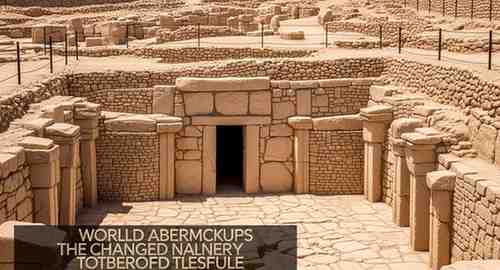
Göbekli Tepe Discovery Redefines Origins of Religion and Civilisation
Göbekli Tepe is widely regarded as the oldest known temple complex, dating to around 9600 BCE . Located in present-day Turkey, it was constructed nearly 12,000 years ago—long before the emergence of agriculture, pottery or permanent settlements. Its discovery has significantly altered conventional theories about the development of early human societies.
Architectural and Cultural Features
The site comprises large circular enclosures built with massive T-shaped limestone pillars , some weighing several tonnes. These pillars are decorated with detailed carvings of animals such as foxes, lions and birds.
What makes Göbekli Tepe extraordinary is that it was built by hunter-gatherer communities , indicating advanced planning, coordination and symbolic expression even before settled life began.
Rethinking Civilisation’s Origins
The discovery challenges the traditional sequence that agriculture led to settlement and then to organised religion. Instead, evidence suggests that shared rituals and belief systems may have come first , bringing groups together and possibly encouraging the later development of farming.
This shifts the understanding of early civilisation, highlighting the role of culture and spirituality in shaping social evolution.
Mystery of Burial
A striking feature of Göbekli Tepe is its deliberate burial around 8000 BCE . The structures were intentionally covered rather than abandoned due to natural causes.
The reasons remain uncertain, with theories suggesting changes in belief systems or efforts to preserve the site. Notably, there is little evidence of permanent habitation, indicating it functioned mainly as a ritual centre.
Transition to Settled Life
The eventual decline of the site coincides with the gradual shift from nomadic hunting lifestyles to agriculture-based communities. As settlements emerged, the need for large communal ritual spaces may have reduced.
Thus, Göbekli Tepe represents a critical transitional phase in human history, bridging the gap between mobile hunter-gatherer societies and early settled civilisations.
Exam-Focused Points
-
Göbekli Tepe dates to ~9600 BCE .
-
Older than Stonehenge and Egyptian pyramids .
-
Built by hunter-gatherers , not farmers.
-
Features T-shaped pillars with animal carvings .
-
Deliberately buried around 8000 BCE .
Month: Current Affairs - March 18, 2026
Category: History / Archaeology