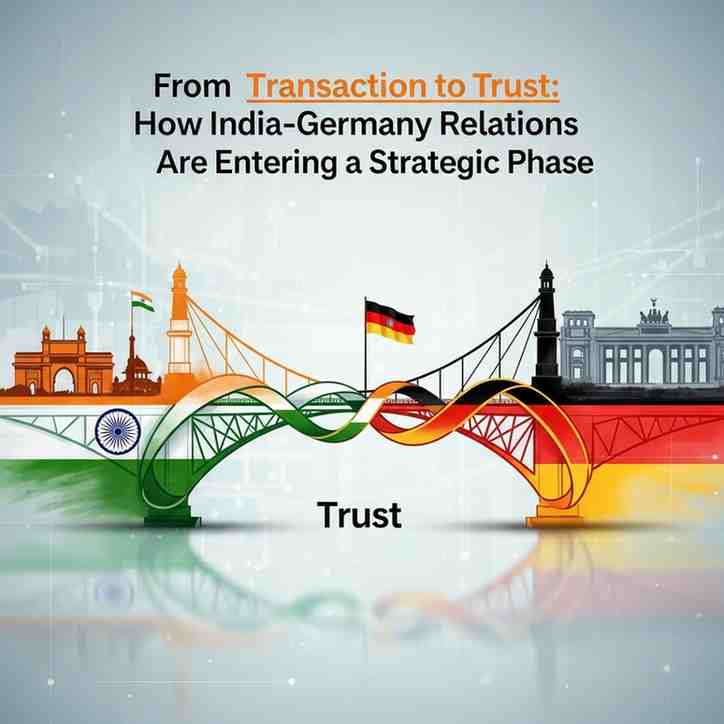
German Chancellor Friedrich Merz’s first official visit to India, though brief, carried weight far beyond protocol. It came at a time when the global order is under strain—from wars in Europe and West Asia to fractured supply chains, technological weaponisation, and eroding faith in multilateral institutions. Against this backdrop, the Modi–Merz engagement signalled a deeper shift in India–Germany relations: from issue-based cooperation to strategic convergence rooted in shared interests, democratic values, and pragmatic realism.
A common reading of global instability
A striking feature of the visit was the shared diagnosis offered by New Delhi and Berlin on the state of the world. Chancellor Merz spoke candidly about the weakening of global norms and the limits of existing multilateral frameworks. India, long accustomed to navigating a turbulent international environment, found resonance in this assessment. The message was clear: stabilising the global system can no longer be outsourced to a few powers; responsible democracies must coordinate more closely.
This convergence translated into tangible policy signals. Germany expressed strong support for the early conclusion of the India–EU Free Trade Agreement, stalled for years over regulatory and political differences. Berlin’s backing is critical, given Germany’s economic weight and agenda-setting role within the European Union. For India, this support strengthens its push to anchor growth in diversified, rules-based trade partnerships.
Trade and economic resilience as strategic tools
Economic engagement formed the backbone of the visit. Bilateral trade has reached nearly $51 billion, accounting for about a quarter of India–EU trade. Yet both leaders recognised that sustaining this trajectory requires moving beyond traditional goods exchange.
At the India–Germany CEOs’ Forum, Merz warned against “dangerous one-sided dependencies”—a phrase reflecting Europe’s post-Ukraine reassessment of over-reliance on single suppliers for energy, minerals, or technology. India fits naturally into this recalibration: as a large market, a manufacturing hub, and a partner capable of offering diversification without political volatility. For India, Germany’s de-risking strategy aligns with its own ambition to integrate into global value chains while reducing vulnerability to external shocks.
Technology cooperation in a weaponised world
Technology emerged as a strategic pillar of the partnership. Semiconductors, digital infrastructure, advanced manufacturing, and clean technologies are no longer neutral economic domains; they are increasingly subject to export controls and geopolitical leverage.
India and Germany agreed that trusted partnerships offer the best response—not decoupling, but diversification and redundancy among reliable actors. Cooperation in research, innovation ecosystems, and standards-setting can help both countries reduce exposure to unilateral controls while shaping future technological norms. This reflects a broader shift: technology policy is now inseparable from national security and economic sovereignty.
Defence ties: pragmatism over preaching
Perhaps the most notable evolution was in defence cooperation. Germany has streamlined export clearances for India, clearing long-standing backlogs that once reflected political hesitation. The announcement of a defence industrial cooperation roadmap, including discussions on submarines, signals a new level of strategic comfort.
Equally significant was the tone. India reiterated that its defence procurement is guided by national interest, not ideology. Germany, in turn, avoided public moralising over India’s ties with Russia, signalling a pragmatic security posture. This realism—accepting differences while expanding cooperation—marks a maturation of the relationship.
Green energy as industrial partnership
The visit gave concrete shape to clean energy cooperation through a long-term off-take agreement for green ammonia between India’s AM Green and Germany’s Uniper. This deal aligns
Month: Current Affairs - January 16, 2026
Category: