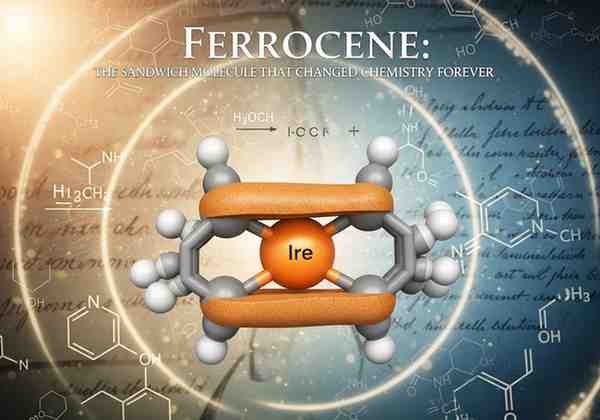
Ferrocene is a tiny sandwich that changed the world of chemistry. For 75 years, it has been a star in laboratories around the globe. Now, Indian scientists have taken its legacy forward by creating a carbon-free version. This achievement puts India at the forefront of inorganic chemistry research. The new molecule, with its osmium centre and boron rings, may one day lead to better batteries, stronger materials, and more efficient medicines. It is a reminder that even after 70 years, there is still so much to discover. Chemistry is not a finished science. It is a living, growing field where small molecules can make a very big difference.
Exam-Focused Points
-
Ferrocene – organometallic compound with formula Fe(C₅H₅)₂ .
-
Structure – iron atom sandwiched between two cyclopentadienyl (carbon) rings (sandwich structure).
-
Discovery – accidentally discovered in 1951 by Kealy & Pauson and Miller et al. independently.
-
Nobel Prize – Ernst Otto Fischer and Geoffrey Wilkinson won the 1973 Nobel Prize in Chemistry for work on sandwich compounds.
-
Appearance – orange crystalline solid with melting point 174°C .
-
Properties – stable up to 400°C , soluble in organic solvents, insoluble in water, undergoes aromatic substitution reactions .
-
Applications – medicines, batteries, sensors, catalysis, fuel additives, advanced materials .
-
2026 Breakthrough – IIT Madras and IISc Bengaluru created carbon-free analogue using boron rings and osmium metal .
-
New compound – ((B₅H₁₀)Os(B₅H₁₀)) – has stronger bonding than ferrocene.
-
Significance – proves sandwich structures not exclusive to carbon; launches new field of "inorganometallics" .
FAQ (Frequently Asked Questions)
Q1: What is the physical appearance of Ferrocene?
A: Ferrocene is an orange crystalline solid with a camphor-like odour. It has a melting point of about 174°C (345°F).
Q2: Who discovered Ferrocene and in which year?
A: Ferrocene was discovered in 1951 by two independent groups: Kealy & Pauson, and Miller, Tebboth & Tremaine.
Q3: What is the unique structure of ferrocene?
A: Ferrocene has a "sandwich" structure where an iron atom is placed between two parallel five-membered carbon rings called cyclopentadienyl rings.
Q4: What is the carbon-free alternative to ferrocene that Indian scientists created?
A: In 2026, researchers from IIT Madras and IISc Bengaluru created a carbon-free analogue of ferrocene using boron rings and the metal osmium. Its formula is ((B₅H₁₀)Os(B₅H₁₀)).
Q5: What are the main applications of ferrocene?
A: Ferrocene is used in medicines, batteries, sensors, catalysis, fuel additives, and advanced materials. It is valued for its stability and ability to transfer electrons easily.
Month: Current Affairs - May 26, 2026
Category: Chemistry, Science and Technology