other scientists: Robert Burns Woodward and Ernst Otto Fischer. They worked independently. Later, Fischer and Geoffrey Wilkinson were awarded the Nobel Prize in Chemistry in 1973 for their work on sandwich compounds. The discovery of ferrocene launched the entire field of organometallic chemistry. It showed that metals and organic molecules could combine in ways that no one had imagined before.
The Unique Sandwich Structure
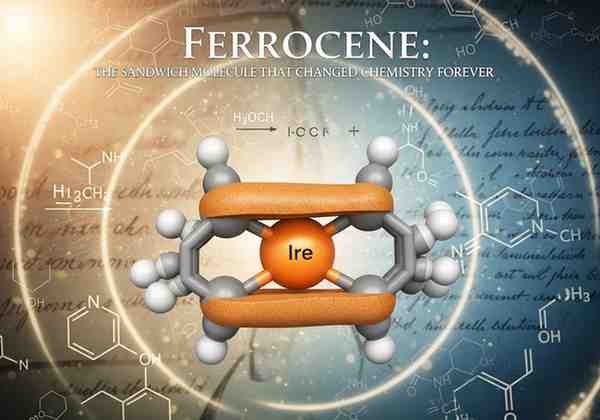
The structure of ferrocene is what makes it so special. Two flat cyclopentadienyl rings sit parallel to each other. An iron(II) ion is perfectly centered between them, bonded equally to all ten carbon atoms (five on each ring). This arrangement creates a very stable molecule. The rings can rotate around the iron centre with very little energy, so the molecule is flexible as well as strong.
In the new carbon-free analogue, the sandwich looks very similar but with key differences. The central metal is osmium, not iron. The rings are made of boron and hydrogen, not just carbon. And interestingly, the boron rings are not flat like carbon rings. They have bridging hydrogen atoms that help them grab the metal atom even more tightly. As a result, the bonding in the new compound is stronger than in ferrocene itself.
Properties and Applications of Ferrocene
Ferrocene is valued for several key properties. It is chemically stable, thermally stable, and can easily transfer electrons (a property called redox behaviour). These properties make ferrocene useful in many areas:
-
Medicine : Ferrocene derivatives have been studied as potential drugs for anaemia, malaria, and cancer.
-
Catalysis : Ferrocene and its derivatives act as catalysts in many chemical reactions, including asymmetric synthesis.
-
Batteries and Energy Storage : Ferrocene's ability to transfer electrons makes it valuable in flow batteries and other energy storage devices.
-
Sensors : Ferrocene-based compounds are used in electrochemical sensors for detecting various substances.
-
Fuel Additives : Ferrocene is added to fuels to improve combustion and reduce smoke.
-
Advanced Materials : Ferrocene is used in creating conductive polymers and other smart materials.
The Significance of the Carbon-Free Breakthrough
Why is the new carbon-free ferrocene such a big deal? There are several reasons:
First, it answers a fundamental scientific question. It proves that stable sandwich structures can exist without carbon. This expands the frontiers of inorganic chemistry.
Second, it launches a new field. Just as ferrocene created organometallic chemistry, this discovery could create "inorganometallics" – a whole new branch of chemistry focused on metal-boron sandwich compounds.
Third, the new molecule has a stronger bond than ferrocene. This means it may be stable at even higher temperatures. That could lead to new catalysts that work under extreme conditions, making industrial processes more efficient.
Fourth, boron chemistry is a hot topic right now. Scientists are exploring two-dimensional materials called borophenes. The discovery of stable boron-based sandwiches opens up possibilities for creating entirely new materials with unique electronic and mechanical properties.
Conclusion: A Small Molecule with a Big Future
Month: Current Affairs - May 26, 2026
Category: Chemistry, Science and Technology