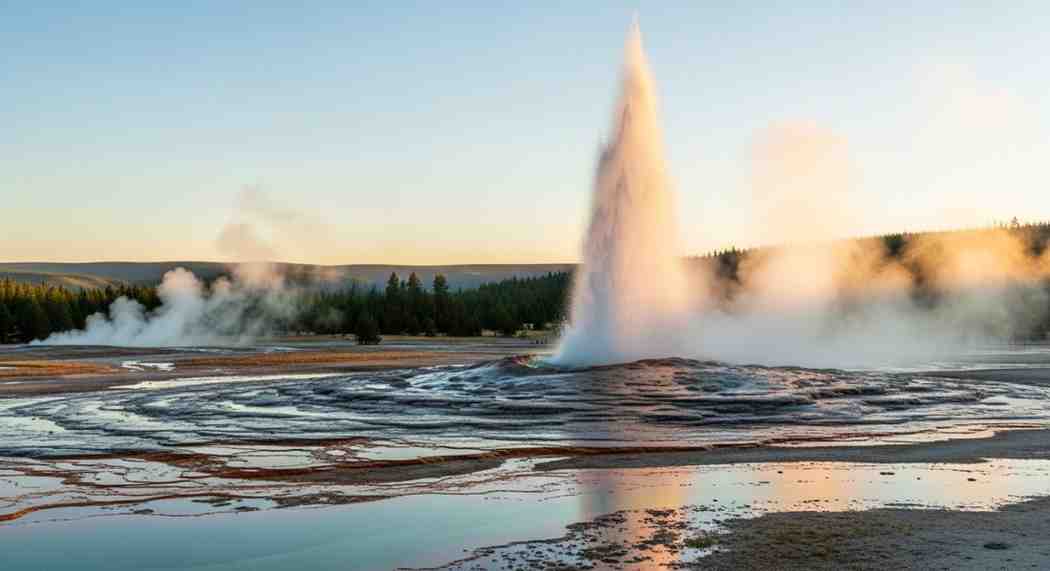
Rare Acidic Geyser Activity Resumes at Yellowstone National Park
Yellowstone National Park has witnessed renewed eruptions from Echinus Geyser after nearly six years of inactivity. The geyser has begun sending bursts of hot, acidic water up to about 30 feet into the air, drawing attention from scientists and visitors. The recent eruptions represent the most regular activity recorded at the site since 2017, highlighting the constantly evolving hydrothermal systems beneath Yellowstone.
Distinctive Structure and Visual Features
Unlike many cone-shaped geysers, Echinus Geyser consists of a broad hot spring pool roughly 66 feet wide. The surrounding terrain is covered with sharp, spiky silica formations resembling sea urchins, which inspired the geyser’s name.
When active, the geyser erupts at intervals of a few hours, releasing jets of acidic water that can reach heights of 20–30 feet. The pool’s rim displays striking colours such as red, orange and yellow due to mineral deposits including iron, aluminium and arsenic.
Although the water is acidic, its pH level is similar to substances like vinegar or citrus juice. However, the extremely high temperature of the water makes it hazardous.
Rare Chemistry of an Acidic Geyser
Acidic hot springs rarely evolve into geysers because strong acid dissolves the underground silica formations that normally trap steam and allow pressure to build. Without such structures, water typically only bubbles at the surface rather than erupting.
Echinus Geyser appears to maintain a delicate balance between neutral groundwater and acidic gases rising from deeper underground layers. This combination preserves the underground plumbing system that enables periodic eruptions, making such acidic geysers exceptionally rare worldwide.
Changing Activity Patterns
The eruption history of Echinus has varied over decades. During the 1970s, eruptions occurred frequently at intervals of about 40–80 minutes. In the 1980s and 1990s, some eruptions reached heights of up to 75 feet and lasted for more than an hour.
Activity declined in the early 2000s, and the geyser eventually became dormant again in December 2020. In February 2026, scientists noticed rising temperatures in nearby runoff channels, followed by renewed eruptions lasting two to three minutes and reaching heights of 20–30 feet.
Important Facts for Exams
-
Yellowstone National Park contains the largest concentration of geysers in the world.
-
Echinus Geyser is considered the largest known acidic geyser.
-
Norris Geyser Basin is the park’s most dynamic thermal region.
-
Steamboat Geyser is also located in Yellowstone.
Geological Safety and Monitoring
The renewed activity coincided with eruptions at Steamboat Geyser, leading to speculation about possible volcanic unrest. However, geologists confirm that Yellowstone’s volcanic system remains stable. In February 2026, only 74 small earthquakes were recorded in the park, the largest measuring magnitude 2.4.
Experts emphasise that geyser eruptions are primarily controlled by shallow groundwater circulation rather than deep magma movement. Despite the dramatic eruptions, Yellowstone continues to operate within its normal geological activity range.
Month: Current Affairs - March 05, 2026
Category: Geography | Geology