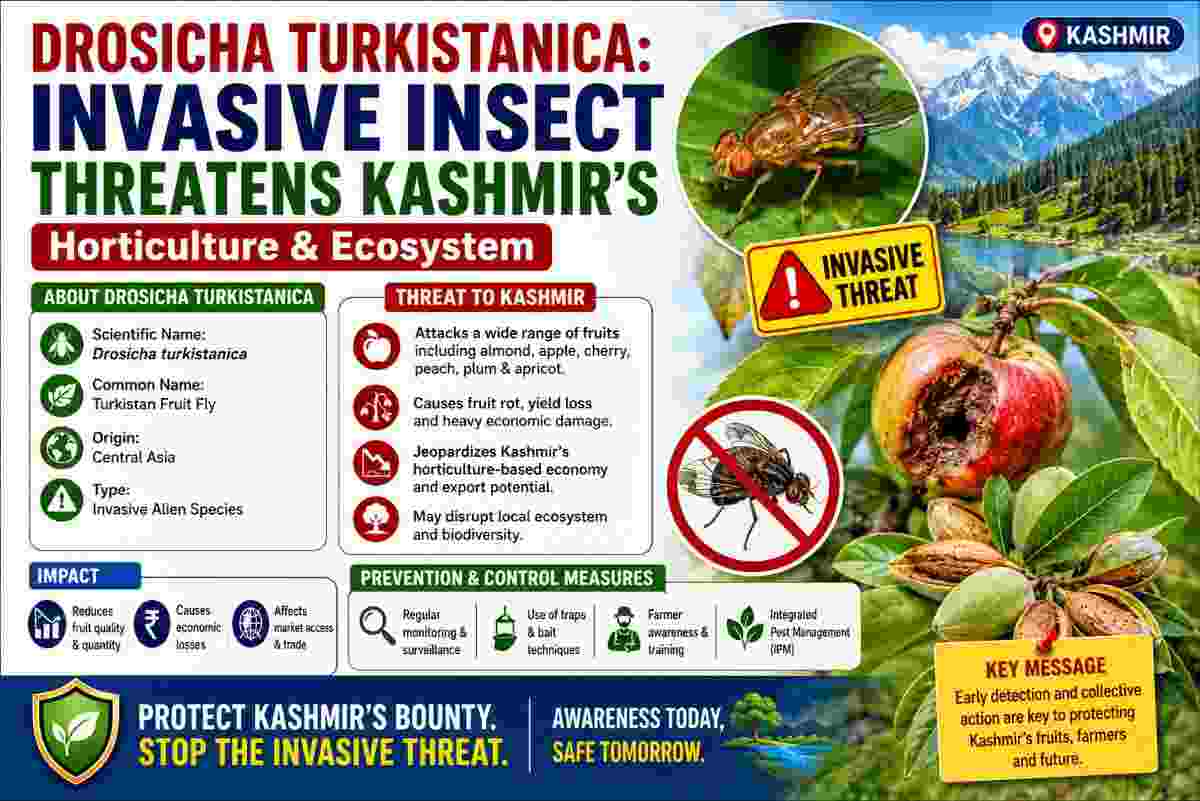
Overview :
An invasive sap-sucking insect, Drosicha turkistanica , has been detected in poplar and willow plantations in South Kashmir. Identified by the National Bureau of Agricultural Insect Resources, the pest threatens the region's poplar and willow economy. Imported planting material is the suspected entry route.
What is Drosicha turkistanica ?
Drosicha turkistanica is a scale insect that feeds on plant sap. Its feeding weakens trees and can reduce plantation survival.
Why Poplar and Willow Matter
Poplar and willow are critical for farm forestry, timber, and plywood in Kashmir. This pest threatens the livelihood of rural families.
The Identification
Samples were collected from the Mountain Research Centre for Field Crops in Khudwani and sent to Bengaluru for identification.
The Biosecurity Gap
The entry of the pest via imported planting material highlights a gap in quarantine measures. This is a warning sign for the future.
Control Measures
Scientists advise against widespread pesticide use, as it may harm the environment and is not a guaranteed solution.
Exam-Focused Points :
-
Species Drosicha turkistanica – an invasive sap-sucking insect.
-
Location Hanjipora (Pulwama), Kulgam, and Anantnag in South Kashmir.
-
Host Plants Poplar and willow trees.
-
Identification Specimens identified by the National Bureau of Agricultural Insect Resources, Bengaluru.
-
Taxonomy Order Hemiptera, family Monophlebidae.
-
Appearance Snow-white, cotton-like masses on tree trunks.
-
Entry Pathway Suspected via imported planting material.
FAQs :
Q1: What is Drosicha turkistanica ?
An invasive sap-sucking insect that attacks poplar and willow trees.
Q2: Where has it been found?
In Hanjipora, Kulgam, and Anantnag in South Kashmir.
Q3: What plants does it attack?
Poplar and willow trees.
Q4: How did it enter Kashmir?
It is suspected to have come through imported planting material.
Q5: What is the recommended control method?
Quarantine and expert diagnosis; avoid indiscriminate pesticide use.
Month: Current Affairs - Aug 20, 2026
Category: Agriculture and Economy