Sansha Yongle Blue Hole Depth, Formation, and Exam Notes Youtube Link
Blue holes remain among the least explored marine landforms, concealing dramatic vertical drops beneath seemingly tranquil waters. The Sansha Yongle Blue Hole , widely known as the Dragon Hole, continues to attract scientific attention despite no longer holding the global depth record. Its physical complexity and chemical isolation make it a valuable natural laboratory.
Structural Complexity
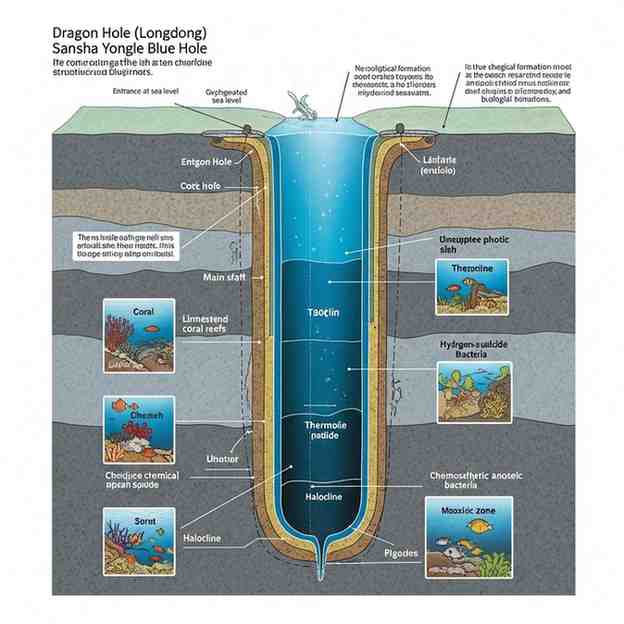
Contrary to early assumptions, the Dragon Hole is not a simple vertical cavity. High-resolution surveys reveal a bent, tilted passageway. The deepest point lies significantly offset from the surface opening, indicating prolonged geological evolution rather than sudden collapse. The entrance widens near the top, constricts at mid-depth, and expands again deeper down. Limestone reef formations dominate the interior, shaped by dissolution and erosion.
Advances in Mapping
Initial depth measurements were inconsistent due to navigational challenges within the irregular shaft. Precision mapping became possible when researchers deployed a remotely operated vehicle equipped with advanced positioning systems. Cross-verification of instruments established the confirmed depth at 301.19 metres , with very low uncertainty. The survey also produced the first reliable three-dimensional model.
Geological Interpretation
Stone ledges inside the cavity align with historic sea-level stands. These terraces correspond to glacial cycles when sea levels were lower. Such features indicate stepwise enlargement influenced by climatic fluctuations over millennia.
Chemical Stratification
A pronounced transition occurs below roughly 100 metres. Oxygen levels decline rapidly, giving way to anoxic conditions and detectable hydrogen sulphide. Weak water circulation prevents mixing, preserving stable chemical layers.
Exam-Focused Points
-
Blue holes are submerged sinkholes formed mainly in carbonate rocks.
-
Dragon Hole depth: 301.19 metres .
-
Morphology indicates multi-stage geological development.
-
Internal terraces record past sea-level variations.
-
Strong chemical stratification limits biological activity.
Month: Current Affairs - February 12, 2026
Category: Physical Geography | Oceanography