Powerful Cosmic “Space Laser” Detected in Distant Galaxy by MeerKAT Telescope
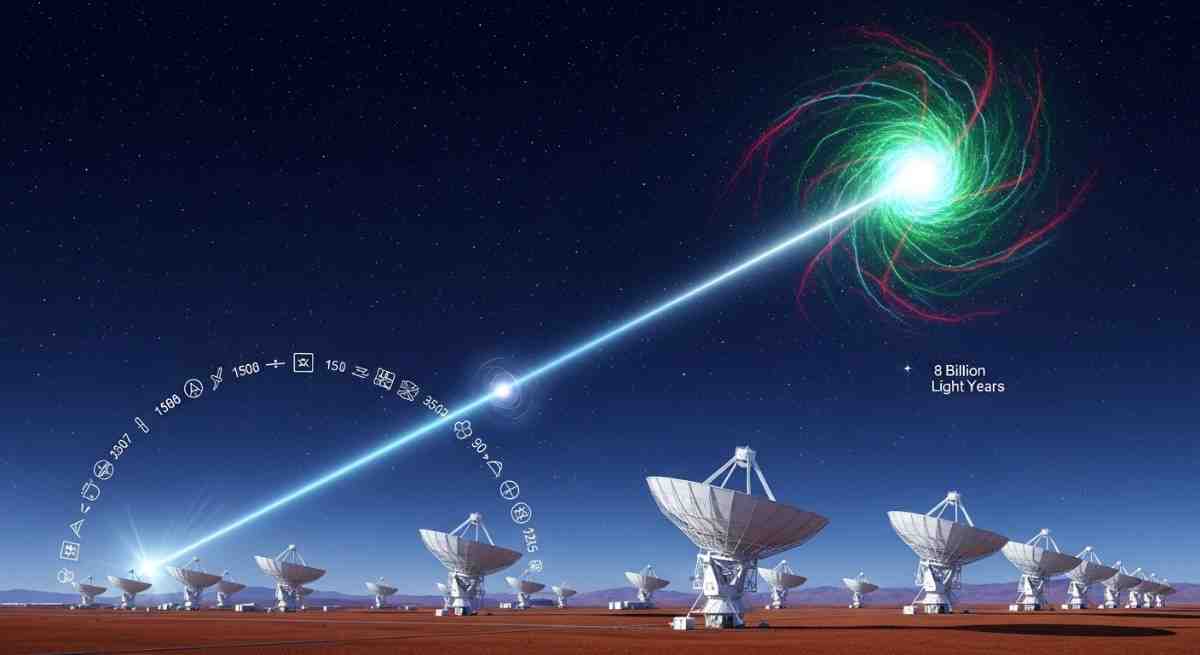
Astronomers have identified an exceptionally powerful cosmic “space laser,” known as a hydroxyl megamaser , in a distant galaxy located more than 8 billion light-years from Earth . The discovery was made with the MeerKAT Radio Telescope in South Africa. Scientists consider it one of the most distant and energetic megamasers ever detected. The research findings have been accepted for publication in Monthly Notices of the Royal Astronomical Society Letters , offering valuable insights into how galaxies behave during intense cosmic collisions.
Hydroxyl megamasers are extremely bright radio emissions that form when gas-rich galaxies collide and merge . During these interactions, enormous amounts of interstellar gas become compressed, which stimulates hydroxyl (OH) molecules to amplify radio waves. This mechanism resembles how lasers operate, but instead of producing visible light, megamasers emit radio-frequency radiation , typically at wavelengths around 18 centimetres . Because of their immense brightness, these signals can travel across vast cosmic distances and still be detected from Earth.
The newly discovered megamaser was observed at a redshift of 1.027 , meaning the light has travelled for more than eight billion years to reach Earth. Earlier surveys had identified megamasers only up to a redshift of about 0.25 , making this discovery a major advancement in deep-space observation. Researchers used advanced computational tools and data-analysis algorithms to isolate the signal from large volumes of radio-telescope data.
The signal was further strengthened by Gravitational Lensing , a process in which a massive foreground galaxy bends and magnifies radiation coming from a more distant object. Acting like a natural cosmic lens, the intervening galaxy amplified the radio emission, allowing astronomers to detect the megamaser more clearly. The object lies in the galaxy system HATLAS J142935.3–002836 and is so luminous that scientists describe it as a “gigalaser.”
The discovery highlights the remarkable capability of MeerKAT and strengthens the scientific potential of the upcoming Square Kilometre Array , which aims to become the world’s most powerful radio astronomy observatory.
Exam-Focused Key Points
-
A megamaser is a natural cosmic source that amplifies microwave or radio radiation through stimulated emission.
-
The detected hydroxyl megamaser is located over 8 billion light-years away at redshift 1.027 .
-
The discovery was made using the MeerKAT radio telescope in South Africa .
-
Gravitational lensing by a foreground galaxy amplified the radio signal.
-
The megamaser lies in the galaxy system HATLAS J142935.3–002836 .
-
MeerKAT is a precursor instrument for the Square Kilometre Array (SKA) project.
Month: Current Affairs - March 09, 2026
Category: Astronomy | Space Science