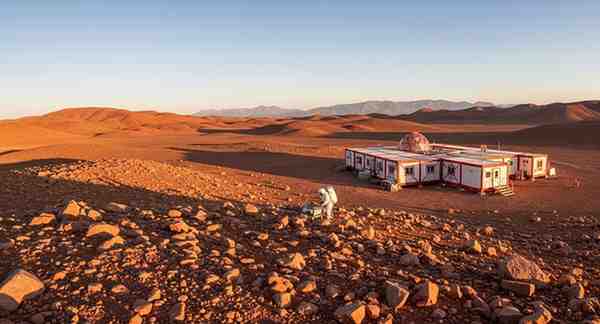
Scientists Study Devon Island to Prepare for Future Mars Missions
Scientists searching for ways to support human life on Mars are studying Devon Island , a remote Arctic region whose environment closely resembles the conditions of the Red Planet. Located in Nunavut , the island is the largest uninhabited island in the world . Its barren landscape, extreme cold and geographic isolation provide researchers with a natural laboratory for testing technologies and survival strategies intended for future missions to Mars .
Why Devon Island Resembles Mars
Devon Island is classified as a polar desert , meaning it experiences extremely low temperatures, minimal precipitation and almost no vegetation. One of the island’s most notable geological features is the Haughton Impact Crater , which spans nearly 20 kilometres in diameter .
The crater’s rocky surface, sparse soil and harsh environmental conditions resemble the terrain observed on Mars , making the site useful for studying planetary geology and testing equipment designed for Martian exploration.
Testing Technology for Mars Exploration
Research teams from organisations such as NASA use the island to test advanced space technologies. Experiments include trials of planetary rovers, autonomous drones and deep-drilling systems that may one day operate on Mars.
These systems must function reliably in extremely harsh environments where repairs would be difficult or impossible. The challenging Arctic conditions allow engineers to evaluate the durability and performance of these technologies before they are used in space missions.
Studying Human Survival and Agriculture
Scientists also conduct experiments on Devon Island to understand how humans might live and grow food on Mars. One example is the Arthur Clarke Mars Greenhouse , an experimental facility designed to test plant growth in soil conditions similar to those expected on Mars.
Simulated missions conducted on the island also help astronauts prepare for the psychological effects of isolation and confinement , which would likely occur during long-duration space missions.
Insights into Life in Extreme Environments
Researchers study microscopic life forms on Devon Island to understand how organisms survive extreme conditions. In the Haughton Impact Crater , scientists have found “micro-oases” where microorganisms survive by living inside rocks , a process known as endolithic colonisation .
These discoveries help guide the search for possible evidence of past microbial life on Mars .
Exam-Focused Points
-
Devon Island is the largest uninhabited island in the world .
-
The Haughton Impact Crater is about 20 km wide .
-
A polar desert is a cold desert region with extremely low precipitation and sparse vegetation.
-
Astrobiology studies the origin, evolution and possibility of life beyond Earth.
-
Devon Island is used to test technologies for potential missions to Mars .
Month: Current Affairs - March 14, 2026
Category: Science & Technology