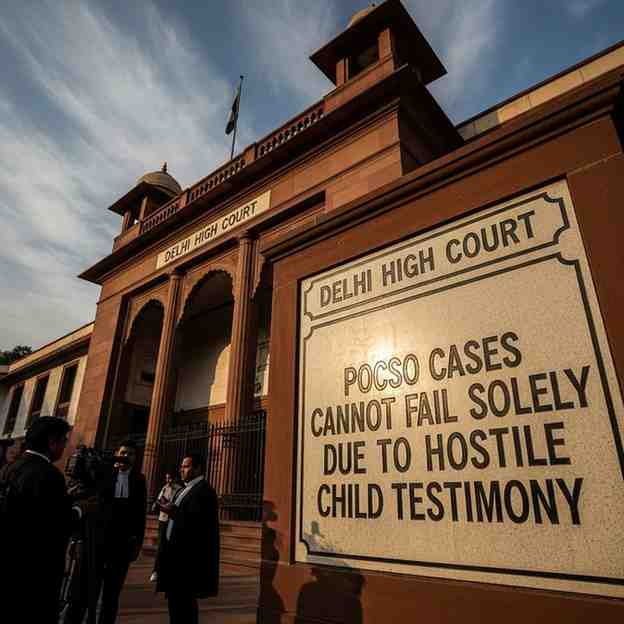
High Court Reinforces Protective Spirit of POCSO
The Delhi High Court has ruled that criminal proceedings under the Protection of Children from Sexual Offences (POCSO) Act cannot be dismissed merely because a child victim turns hostile during trial. The court stressed that such cases must be evaluated in light of the child’s vulnerability, power imbalance, and supporting medical or forensic evidence, particularly when the accused is a family member or caregiver.
Conviction Upheld Despite Witness Retraction
The judgment was delivered while dismissing an appeal filed by a man convicted of raping his minor stepdaughter. Upholding the 20-year sentence , the court noted that the victim was below 12 years of age at the time of the offence in March 2016 . Although the victim and close family members later retracted their statements during trial, the prosecution case was supported by strong medical and forensic evidence , which the court found sufficient to sustain the conviction.
Familial Pressure and Child Psychology
Justice Amit Mahajan observed that children are especially vulnerable to familial pressure, emotional coercion, and economic dependence . When the accused is the breadwinner or guardian, a child may face a cruel choice between personal safety and family survival. The court held that such pressures often compel children to retract truthful statements, and the justice system cannot treat this as a voluntary or reliable reversal.
Hostility Does Not Erase Accountability
The bench clarified that a child victim cannot be burdened with the responsibility of protecting the perpetrator. It also noted that signs of coercion and hostility were visible even in the victim’s statement recorded under Section 164 of the Criminal Procedure Code , underscoring the need for careful judicial scrutiny rather than mechanical dismissal.
Evidence-Based Approach Under POCSO
The court reaffirmed that under the POCSO framework , hostile testimony must be weighed alongside scientific, medical and circumstantial evidence . It further highlighted the statutory duty of police and child welfare authorities to ensure shelter, protection and rehabilitation, emphasising that subsequent retractions cannot dilute criminal liability under child protection laws.
Important Facts for Exams
-
POCSO Act prioritises child protection over procedural technicalities
-
Hostile testimony does not automatically nullify prosecution
-
Section 164 CrPC governs recording of statements before a magistrate
-
POCSO mandates police to ensure care and protection of child victims
Month: Current Affairs - December 28, 2025
Category: