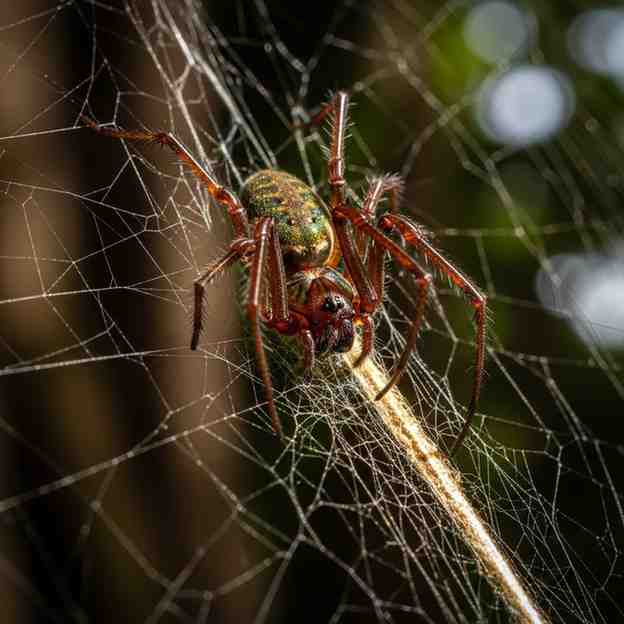
Nature’s Strongest Fibre Comes with Conditions
The Darwin’s bark spider (Caerostris darwini) , native to the forests of Madagascar, produces what scientists recognise as the toughest biological material ever measured. Its dragline silk, with a tensile strength of around 1.6 gigapascals , outperforms steel and most synthetic fibres in both strength and toughness. However, new research shows that this extraordinary property is not uniform across the species and depends strongly on body size, sex, and ecological role.
Evolutionary Link Between Size, Webs and Silk Quality
Among spiders, silk properties are shaped by evolutionary pressures linked to prey capture and web architecture. Larger spiders tend to produce stronger and tougher silk to restrain larger or faster prey. In orb-weaving spiders, increases in body size over evolutionary time have coincided with larger webs and stronger silk threads.
Darwin’s bark spider represents an extreme example. It constructs the largest orb webs ever recorded , sometimes spanning rivers, requiring silk capable of absorbing immense energy without snapping.
Controlled Experiments Across Sex and Age
To understand whether all individuals produce equally strong silk, researchers conducted a comparative study on Caerostris darwini and its close relative Caerostris kütneri . Egg sacs collected from Analamazaotra National Park were reared under controlled laboratory conditions, ensuring uniform diet and humidity. This eliminated environmental variables and allowed scientists to isolate biological differences related to age and sex.
The study, published in Integrative Zoology , examined whether extreme silk toughness was common to all spiders, restricted to females, or limited to large adults with specific ecological roles.
Who Spins the Toughest Silk?
The findings were decisive. Only large adult females produced the exceptionally tough and stiff dragline silk associated with record-breaking strength. Silk spun by males and juveniles of both sexes showed similar mechanical properties and was significantly weaker.
Researchers concluded that adult females activate metabolically expensive physiological pathways for high-performance silk only when their body size and web-building responsibilities demand it. For smaller spiders, such investment offers little benefit.
Energy Costs Shape Silk Strategy
Producing ultra-tough silk is energetically costly, requiring high levels of amino acids such as proline. Adult females offset this cost by building sparser but highly efficient webs , using less silk overall while maintaining strength. In contrast, juveniles and males spin denser webs made from cheaper silk , balancing energy expenditure with survival needs.
This adaptive strategy highlights how sex, size, ecology, and behaviour together shape material performance in nature, even within a single species.
Imporatnt Facts for Exams
-
Darwin’s bark spider produces the toughest biological silk ever recorded
-
Tensile strength of its silk is about 1.6 GPa , higher than steel
-
Exceptionally tough silk is produced only by large adult females
-
Silk production is metabolically expensive and linked to amino acid use
-
Month: Current Affairs - January 22, 2026
Category: Biodiversity & Ecology