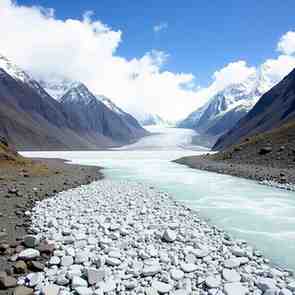
The most recent studies emphasize the increased influence of climate change on the Gangotri Glacier System (GGS), a vital Himalayan glacier that supplies the Ganga river. Temperature and precipitation variations over the past 30 years (1980-2020) have greatly changed its hydrology, and the effects have been severe in terms of agriculture, hydropower, and water supply of the North Indian region.
Gangotri Glacier System
- one of the middle Himalayas' biggest glaciers.
- Millions downstream supported by Lifeline of the Ganga.
- The river flow is a result of snowmelt, glacier melt, rainfall-runoff and base flow, snowmelt has historically dominated at 64%.
Hydrological Shifts
- The contribution to snowmelt decreased to 63% (2010-20) compared with 73% (1980-90).
- Glacier melt: 21%, Rainfall-runoff: 11%, Base flow: 4%.
- There is an increase in temporary snowmelt rise (2010-20), the result of colder winters and more snow.
Warming and Flow Changes
- Mean temperature in the regions increased by 0.5degC (2001-20 vs 1980-2000).
- Previous summer melting changed the peak discharge to July.
- The thickness of the glaciers is dwindling by 46 cm/yr; snout remains receding.
Declining Snow Cover
- Snow space diminishing, diminishing snowmelt mass.
- Rainfall-runoff and base flow was intensified, and to some extent, equivalent to losses.
Water Security Risks
- Past peak flows can lead to crunch at the end of the summer.
- Lower dry-season flow poses a risk to irrigation and hydropower.
- The loss in the mass of glaciers over a long period of time is an indicator of escalating stress on the Ganga basin.
Month: Current Affairs - Aug 31, 2025
Category: current affairs daily