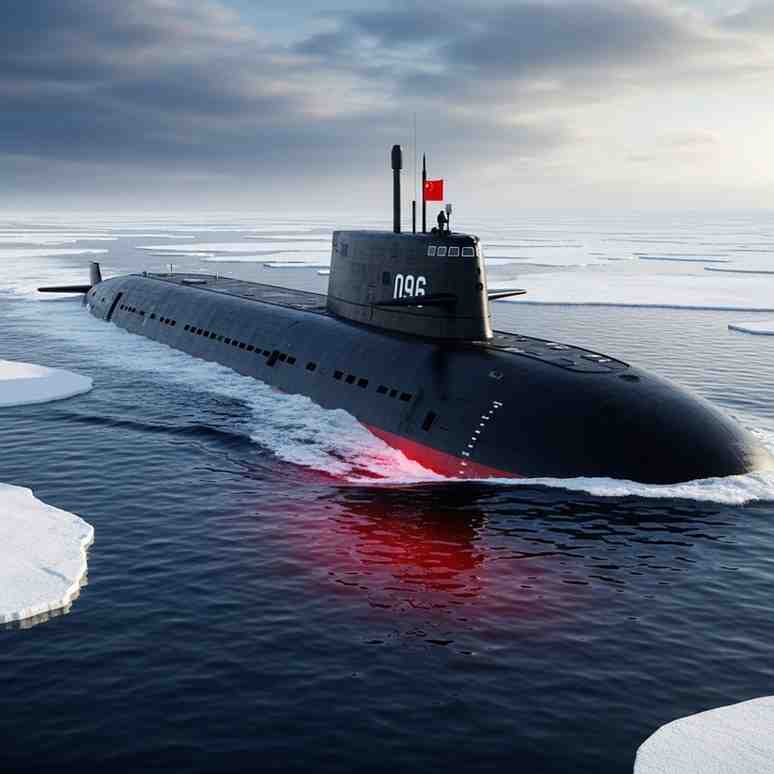
China has revealed its most advanced ballistic missile submarine, the Type 096 Tang-Class , marking a major leap in its undersea nuclear deterrence capability. Unveiled on January 14, the platform signals a decisive shift in China’s maritime strategy, as it seeks to narrow the long-standing gap with established naval powers in sea-based nuclear deterrence.
Strategic Leap in China’s Nuclear Posture
For decades, the sea-based leg of the nuclear triad has been dominated by the United States and Russia. With the induction of the Type 096, China is moving towards a more credible and survivable second-strike capability. Unlike earlier Chinese ballistic missile submarines, which were considered noisier and operationally constrained, the Tang-Class reflects a doctrinal shift towards long-duration patrols, stealth, and assured retaliation.
Analysts view the development as part of China’s broader effort to ensure that its nuclear forces can survive a first strike and remain effective in increasingly contested maritime environments.
Design, Displacement and Stealth Enhancements
Chinese sources indicate that the Type 096 has a submerged displacement of 15,000–20,000 tonnes , placing it in the same strategic category as the Ohio-class and the upcoming Columbia-class submarines of the United States Navy . The increased size allows for a more powerful nuclear reactor, greater missile capacity, and advanced noise-reduction architecture.
Key stealth features reportedly include raft-mounted machinery, hull isolation systems, and enhanced vibration dampening to significantly reduce acoustic signatures. Such measures are critical for ballistic missile submarines, whose survivability depends on remaining undetected in deep oceans.
Missile Capability and Strategic Reach
According to defence reports, the Type 096 is expected to carry up to 24 JL-3 submarine-launched ballistic missiles (SLBMs) . The JL-3 is believed to have intercontinental range, enabling China to target distant adversaries while remaining within protected bastions.
Comparisons have been drawn with Russia’s Borei-class submarines, with some analysts suggesting that Chinese designers may have benefited from indirect exposure to Russian quieting technologies developed by Russia .
Propulsion, Sensors and Combat Systems
The submarine is powered by a pressurised water-cooled nuclear reactor driving a single shaft through a steam turbine. Reports suggest improved propulsion efficiency, possibly including quieter propeller designs or pump-jet systems.
In addition to its strategic role, the Type 096 is equipped with six 533-mm torpedo tubes capable of launching Yu-6 heavy torpedoes. Advanced towed-array sonar, acoustic decoys, and countermeasures enhance its situational awareness and defensive survivability against anti-submarine threats.
Important Facts for Exams
-
Type 096 Tang-Class is China’s latest ballistic missile submarine (SSBN) .
-
It is expected to carry JL-3 long-range SLBMs .
-
Sea-based deterrence forms one leg of the nuclear triad .
-
Stealth and acoustic quieting are essential for SSBN survivability.
-
The submarine’s displacement places it alongside top global SSBN classes.
Month: Current Affairs - January 21, 2026
Category: Defence & Security | Nuclear Deterrence