China’s New Ethnic Unity Law to Take Effect from July 2026
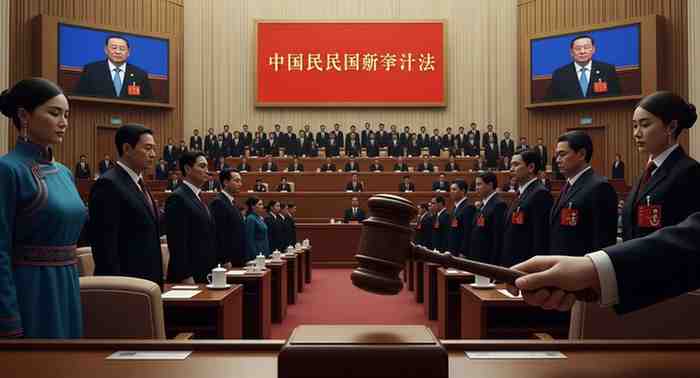
China has enacted a new law titled Promoting Ethnic Unity and Progress Law , designed to promote national unity among the country’s diverse ethnic communities. The legislation was approved by the National People’s Congress with an overwhelming majority and will come into effect on 1 July 2026 . The measure forms part of broader efforts by the ruling Chinese Communist Party to reinforce political stability and national integration.
Promoting Shared National Identity
The new law seeks to strengthen a unified Chinese identity across the nation’s 56 officially recognised ethnic groups . While Han Chinese account for over 91% of the population , minority groups such as Tibetans, Uyghurs, Mongols, Hui, and Manchus inhabit vast regions rich in natural resources and covering a significant portion of China’s territory.
The legislation promotes closer integration through policies involving education, migration, housing, cultural exchanges, tourism, and regional development .
Mandarin as Central Language of Administration
One of the major provisions of the law emphasises the use of Mandarin (Putonghua) as the principal language in education and official communication. Schools and public institutions are required to prioritise Mandarin in instruction and administrative activities.
In locations where both Mandarin and minority languages appear in signage or communication, the law mandates that Mandarin be given primary prominence , while minority languages and scripts will continue to be formally protected.
Religious and Social Integration Measures
The law also reinforces the state policy of “Sinicisation of religion,” which requires religious institutions to align practices with Chinese cultural and political values. Authorities argue that this approach ensures compatibility between religious activity and national governance.
Additionally, the legislation discourages restrictions on inter-ethnic marriages based on religion, customs, or ethnicity, aiming to encourage social interaction and integration among communities.
Debate and International Attention
While Chinese officials describe the law as a step toward national cohesion and development, some analysts have raised concerns that it may accelerate assimilation of minority cultures into the dominant Han identity. Critics suggest the measure may place greater pressure on minority communities to demonstrate loyalty to the central government.
Exam-Focused Points
-
National People’s Congress is the supreme legislative institution in China.
-
China officially recognises 56 ethnic groups , with Han Chinese forming about 91% of the population .
-
Policies of “Sinicisation” aim to align religion and cultural practices with state ideology.
-
Major minority regions include Tibet , Xinjiang , and Inner Mongolia .
-
Language policy promotes Mandarin as the primary medium of education and administration .
Month: Current Affairs - March 14, 2026
Category: International Relations