Overview :
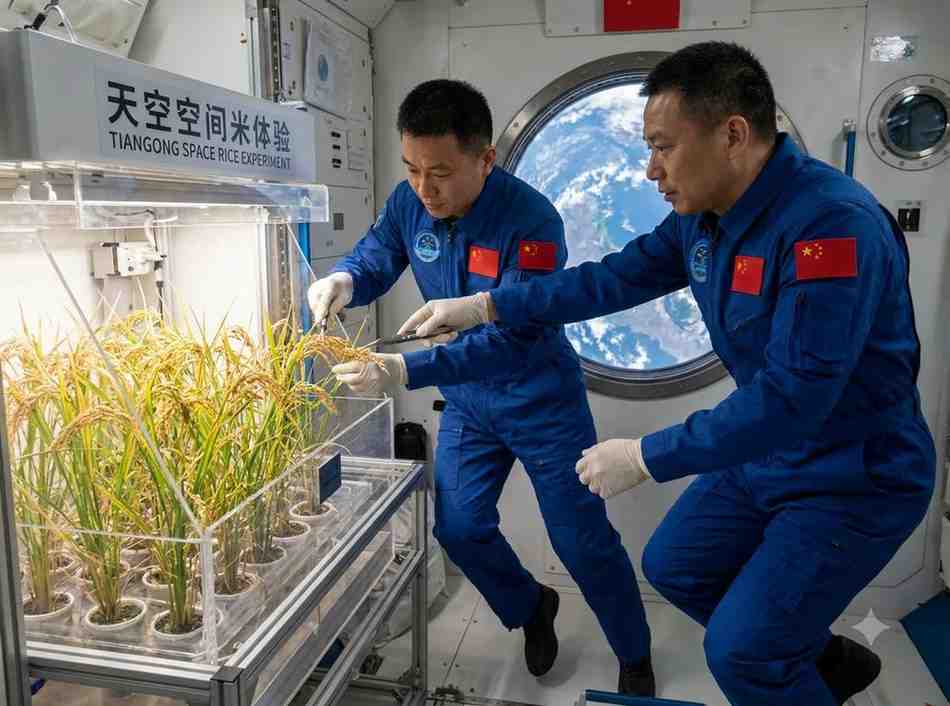
Chinese astronauts aboard the Tiangong space station harvested the first batch of orbit-grown rice on August 5, 2026, as part of the Shenzhou-23 mission. The experiment aims for two-generation rice cultivation in microgravity. Scientists will study plant development, genetic stability, and seed reproduction to support future space farming.
Why Space Rice Matters
Think of space-grown rice as the first step toward sustainable agriculture beyond Earth. If humans establish Moon bases or Mars colonies, they cannot rely solely on Earth resupply. In-situ food production becomes essential. Rice—a staple for billions—represents a test case for crop cultivation in alien conditions.
The Two-Generation Challenge
Previous experiments grew one generation. This experiment aims for two consecutive life cycles—seed to plant to seed again. Successful reproduction in space would prove plants can complete their entire life cycle in microgravity. Think of it as proving agriculture can sustain itself off-Earth.
Ratooning: A Smart Shortcut
Ratooning allows two harvests from one planting. New shoots grow from existing roots after the first harvest. This reduces the need to carry fresh seeds—efficient for long-duration missions where weight and volume are limited.
Space Lineage Seeds
The experiment uses two types of seeds:
-
Ordinary seeds Never been to space
-
Space lineage seeds Descended from 2022 space-grown rice, bred on Earth for three generations
Comparing their performance reveals whether space exposure creates inheritable changes—valuable for understanding genetic adaptation.
Previous Milestone
In 2022, China completed a full rice life cycle in space—producing 59 seeds returned to Earth. That experiment validated basic feasibility. This harvest builds on that foundation—moving toward sustainable cultivation.
Global Context
China joins the US and India in exploring space agriculture. Each nation contributes knowledge toward eventual food security beyond Earth. The findings could also benefit terrestrial agriculture—understanding how plants respond to stress conditions.
Exam-Focused Points :
-
Harvest date August 5, 2026, aboard Tiangong space station
-
Mission Shenzhou-23 (launched May 24, 2026)
-
Crew Zhu Yangzhu, Zhang Zhiyuan, Lai Ka-ying
-
Rice types Ordinary seeds + "space lineage" seeds (descended from 2022 Tiangong rice, bred 3 generations on Earth)
-
Reproduction methods Seed-to-seed sexual reproduction + ratooning (new shoots from remaining roots)
-
Objective First continuous cultivation of two rice generations in orbit
-
Future application Support food production for Moon and Mars missions
FAQs :
Q1: Which space station hosted the rice harvest?
China's Tiangong space station in low Earth orbit.
Q2: Which mission carried out the experiment?
Shenzhou-23, launched on May 24, 2026.
Q3: What is ratooning?
A method where new shoots grow from remaining roots after harvest, producing a second crop.
Q4: What types of seeds were used?
Ordinary japonica rice seeds and "space lineage" seeds from 2022 space-grown rice bred on Earth for three generations.
Q5: What is the ultimate goal of this experiment?
To understand plant growth in microgravity and support food production for future deep-space missions.
Month: Current Affairs - Aug 06, 2026
Category: Space Agriculture