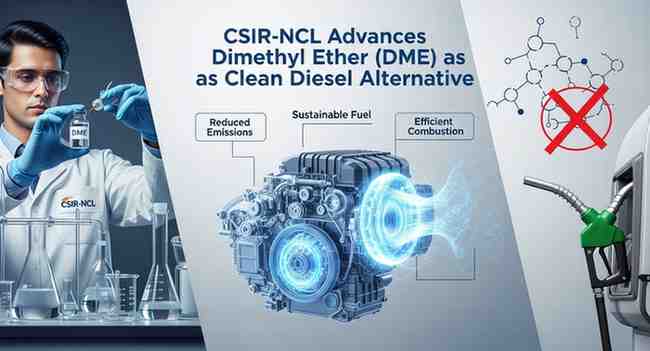
Dimethyl Ether Technology Gains Momentum in India’s Clean Energy Push
The CSIR-National Chemical Laboratory has initiated plans to scale up Dimethyl Ether (DME) technology to an industrial demonstration level with support from an engineering partner. This move is aimed at promoting cleaner fuels and reducing reliance on conventional diesel, especially in sectors like agriculture and transport.
What is Dimethyl Ether?
Dimethyl Ether is a man-made fuel that can substitute diesel in specially adapted compression ignition engines. It can be produced from diverse sources such as natural gas, coal, biomass and even waste materials.
Its flexibility in production and clean-burning nature make it an attractive option for sustainable energy, particularly for heavy-duty vehicles and industrial uses.
Key Properties of DME
Dimethyl Ether offers several technical advantages:
-
High cetane number , ensuring efficient ignition
-
Exists as a colourless gas under normal conditions
-
Produces negligible soot and particulate matter
-
Emits significantly lower nitrogen and sulphur oxides
-
Provides efficiency comparable to diesel engines
These characteristics make it a strong candidate for reducing pollution from diesel-based systems.
Role in India’s Energy Transition
India’s agriculture and transport sectors are heavily dependent on diesel-powered engines. With minor modifications, these engines can operate using Dimethyl Ether , making the transition relatively feasible.
Adoption of DME could help lower emissions, diversify fuel sources and strengthen energy security while supporting climate goals.
Industrial Applications
Apart from fuel use, Dimethyl Ether has significant industrial value. It is widely used as an aerosol propellant and serves as a chemical intermediate in manufacturing products such as plastics, dyes and other compounds.
Its dual role in both energy and chemical sectors enhances its overall economic importance.
Exam-Focused Points
-
Dimethyl Ether is a clean alternative to diesel fuel .
-
Developed and scaled by CSIR-National Chemical Laboratory .
-
It has a high cetane number and efficient combustion.
-
Produces very low emissions (soot, NOx, SOx).
-
Can be derived from multiple feedstocks including biomass and waste.
Month: Current Affairs - March 17, 2026
Category: Science & Technology