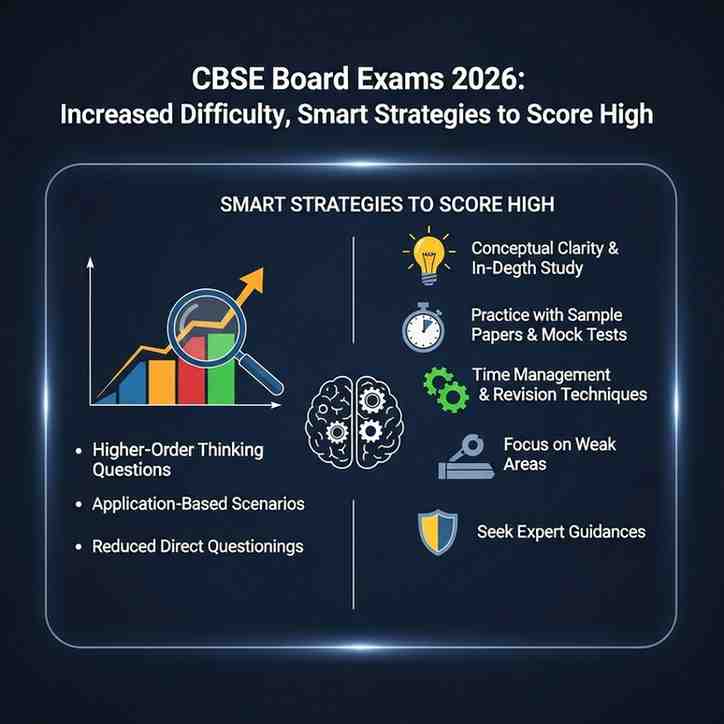
The Central Board of Secondary Education (CBSE) has announced a major upgrade to its evaluation format for the 2026 board examinations , aiming to make learning more analytical and application-driven. Instead of relying heavily on memory-based questions, the new pattern will emphasize understanding, problem-solving, and concept application.
This redesigned format introduces a higher proportion of competency-based questions —including case studies, data-based items, source-referenced analysis, and real-life situational tasks. Nearly 50% of the paper will now evaluate how well students understand a concept and apply it in real-life or academic contexts , rather than simply recalling definitions.
In response to the shift, schools across the country are adjusting evaluation methods, classroom assessments, and teaching styles to build analytical thinking, reasoning, and expression. Students will now be encouraged to write answers in their own words and demonstrate clarity of thought rather than memorising standard textbook paragraphs.
What Changes for Students in 2026?
-
Half of the questions test conceptual understanding & application
-
Reduced weightage for rote learning and direct textbook recall
-
More real-world situations woven into question formats
-
Class assignments & internal tests are being redesigned accordingly
How Students Can Boost Their Scores Under the New CBSE Pattern
1. Focus on Understanding − Not Mugging Up
Learning must go beyond memorisation. Try to grasp why a formula, theory, or process works and link it to real examples. This approach prepares the mind for complex, case-based questions.
2. Frame Answers in Your Own Words
Examiners value originality. Writing in clear, simple language while maintaining technical accuracy shows genuine understanding—something memorised lines fail to prove.
3. Use Real-Life Examples Wherever Possible
When a question demands explanation, strengthen your answer with an illustration from daily life, science experiments, history events, or real-time applications.
This makes responses unique and impactful.
4. Practice Competency-Based Questions
The exam will feature a variety of formats, including:
| Type of Question |
Focus Area |
| MCQs |
Concept recall + quick reasoning |
| Case-based items |
Analysis + multi-step thinking |
| Source-based questions |
Interpretation + inference |
| Data-based problems |
Numerical & graphical reasoning |
| Situation-based tasks |
Practical application of concepts |
To prepare confidently, students should solve as many sample papers, worksheets, and question-banks as
Month: Current Affairs - November 30, 2025
Category: